Slow draining sinks. Gurgling toilets. Foul smells you can’t trace. Tree roots inside your drains cause every one of those symptoms, and by the time you notice them, the damage is usually significant. The good news is that Modern CCTV Technology spots root ingress with pinpoint accuracy long before it destroys your pipework.
This guide explains how Bournemouth drainage engineers use a CCTV drain survey to detect tree roots, what the survey actually reveals, and when you genuinely need one.
Can a CCTV Drain Survey Find Tree Roots in Your Pipes?
Yes, a CCTV drain survey for tree roots is the most reliable detection method available across Bournemouth and Dorset. A high-resolution waterproof camera is fed through the drainage system, providing live video of the pipe interior and identifying root masses, cracks, joint failures, and structural damage that no other method can find without excavation.
In UK drainage practice, a CCTV drain survey for tree roots follows the WRc Manual of Sewer Condition Classification (MSCC5), which assigns standardised codes to every defect found. That means your survey report uses the same terminology that insurers, Wessex Water, and conveyancing solicitors recognise nationally.
How the Technology Actually Works
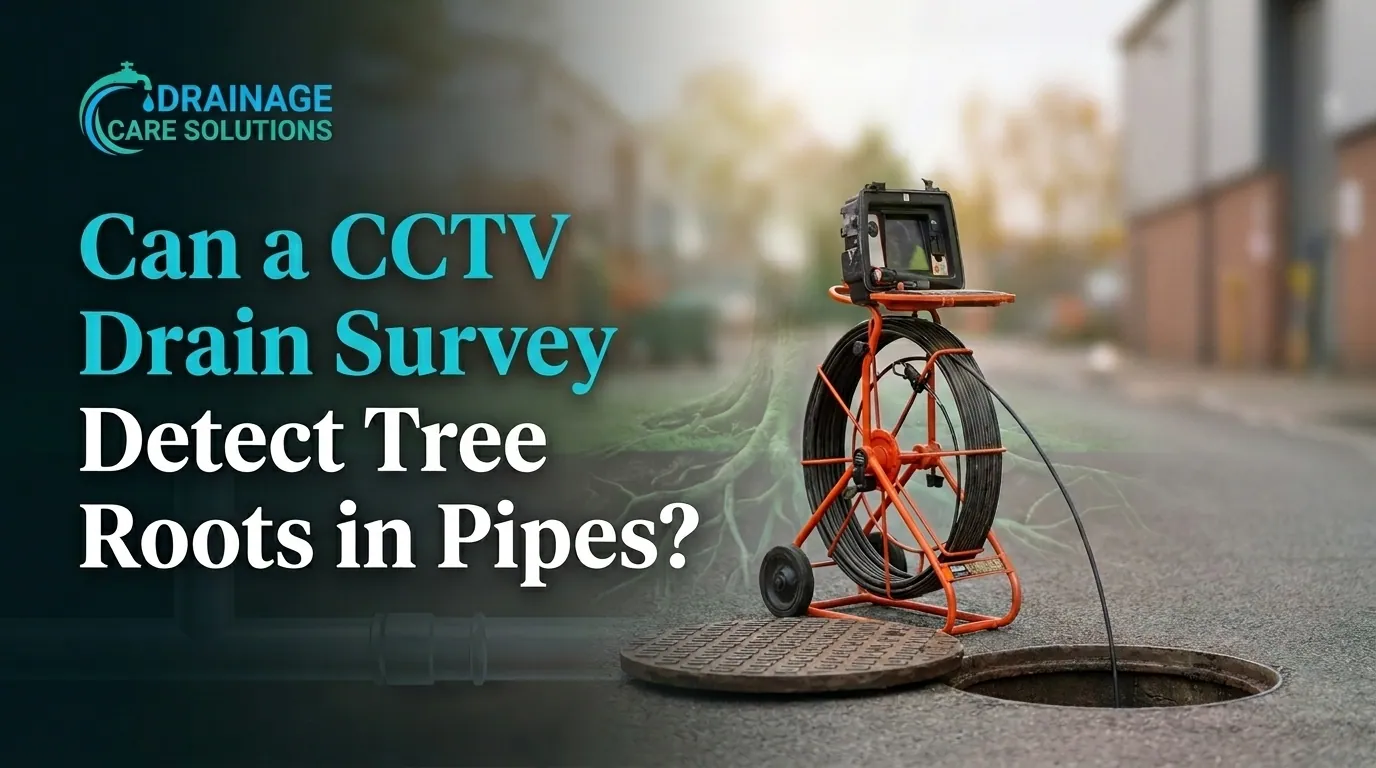
A CCTV drain survey isn’t a domestic camera on a stick. It’s specialist equipment designed for confined, wet, dark pipe environments where standard cameras would fail in seconds.
The kit a Bournemouth drainage engineer brings includes:
- High-resolution waterproof camera head (typically 1080p or 4K).
- Integrated LED lighting array for low-light pipe interiors.
- Pan-tilt-zoom (PTZ) capability for inspecting joints and laterals.
- Sonde transmitter to locate defects precisely from above ground.
- Push rod cable (35m to 120m typical reach) for residential lines.
- Robotic crawler unit for commercial and large-diameter pipes.
- WinCan reporting software for industry-standard digital deliverables.
The engineer guides the camera through the drain run, recording distances, defects, and significant features. Roots appear on screen as fibrous masses entering through joints, cracks, or displaced pipe sections. The sonde transmitter lets the engineer mark the exact location above ground, so any future repair happens precisely where needed rather than across the entire garden.
What Tree Root Damage Looks Like on Camera
Roots don’t enter pipes randomly. They follow predictable patterns, and trained Bournemouth engineers recognise these immediately on the live camera feed during a CCTV drain survey for tree roots.
Classic root intrusion signs include:
- Fine hair-like fibres at joints: Early-stage ingress, easiest to treat.
- Dense root mat partially filling pipe: Established intrusion needing mechanical cutting.
- Roots wrapped around pipe interior: Indicates significant joint failure.
- Roots with attached waste and scale: Long-term blockage building up.
- Roots combined with pipe fracture: Likely requires excavation or lining.
- Roots in lateral connections: Junction or chamber compromise.
The MSCC5 system records each finding with specific defect codes (R for roots, RM for root mass, RF for fine roots, RJ for joint roots) so reports are consistent across the UK drainage industry. Drainage Care Solutions uses these codes on every report so the documentation is recognised by insurers and surveyors across the BH postcode area.
Which Trees Cause the Worst Drain Problems in Bournemouth?
Not all trees are equal threats to your drainage. Some species have aggressive water-seeking root systems that travel 20 metres or more in search of moisture, particularly during dry summers. Bournemouth’s mature gardens and tree-lined streets in Talbot Woods, Branksome, and Westbourne mean root damage is a particularly common issue across the area.
The worst offenders for drain damage in Bournemouth properties:
- Willow (Salix species): The single most invasive UK tree for drains.
- Poplar (Populus): Fast-growing, water-hungry, common in older Bournemouth gardens.
- Sycamore (Acer pseudoplatanus): Aggressive shallow roots, widespread across Boscombe and Moordown.
- Oak (Quercus robur): Major root spread on mature specimens in Talbot Woods.
- Eucalyptus: Extremely thirsty, increasingly popular in coastal Bournemouth gardens.
- Birch (Betula): Shallow rooting, often planted close to houses in newer developments.
- London plane (Platanus x acerifolia): Major offender along older Bournemouth avenues.
If any of these are within 20 metres of your drainage run, particularly with older clay pipework common in Victorian Bournemouth properties, a precautionary CCTV drain survey for tree roots makes sense even before symptoms appear.
When You Should Book a CCTV Drain Survey
Several scenarios make a CCTV drain survey for tree roots genuinely worthwhile rather than precautionary across the Bournemouth area.
Book a survey when you notice:
- Recurring blockages in the same drain run despite repeated clearing.
- Gurgling or bubbling from toilets, sinks, or floor gullies.
- Slow drainage affecting multiple fixtures simultaneously.
- Wet patches in the garden that don’t dry out.
- Sinkholes or soft ground appearing above pipe routes (common in sandy Bournemouth soils).
- Pre-purchase property checks for any Bournemouth home with mature trees nearby.
- Insurance claim preparation for subsidence or drainage damage.
Pre-purchase CCTV surveys are particularly valuable on Bournemouth properties built before 1965, when vitrified clay pipes with mortar joints were standard. Properties from the 1950s to 1970s in Moordown, Kinson, and Wallisdown often have pitch fibre drainage that deforms over time. Both pipe types are highly vulnerable to root ingress and represent a major hidden liability for buyers.
Survey Types Available Across Bournemouth and Dorset
Not all CCTV drain surveys are equivalent. The format you need depends on why you’re booking it.
The three main survey types work as follows.
A basic drainage inspection covers accessible drain runs with a short visual check, usually performed alongside drain unblocking work. It produces video evidence but limited written reporting, making it suitable for confirming a single blockage rather than full property assessment.
A homebuyer drain survey is the standard pre-purchase format used across Bournemouth, Poole, Christchurch, and surrounding Dorset towns. It covers all accessible drains across the property, including a written report with MSCC5-coded defects, photographs, sonde-located pipe plans, and clear recommendations. Conveyancing solicitors and most UK mortgage lenders accept this format as evidence. A CCTV drain survey for tree roots forms part of this assessment where mature trees are present.
An insurance-standard survey is the most detailed option, used for subsidence claims, structural damage cases, and third-party liability disputes. It includes full WRc-coded condition assessment, before-and-after documentation, and engineering recommendations that meet ABI guidance for evidence in claims.
What Happens After Roots Are Found?
Treatment depends on severity. A CCTV drain survey for tree roots doesn’t just diagnose; it also informs the right repair approach.
Standard treatment options used by Bournemouth drainage engineers include:
- High-pressure water jetting: Clears light root ingress and flushes debris.
- Mechanical root cutting: Specialist cutter heads remove established root masses.
- Patch repair: Localised liner installed at a single damaged joint or section.
- Cured-in-place pipe (CIPP) lining: Seamless internal liner along longer runs.
- Pipe bursting: Replacement of severely damaged pipe without trench excavation.
- Open-cut excavation: Full replacement where collapse or major displacement exists.
Modern drainage practice favours no-dig methods wherever possible, since they’re faster, less disruptive, and preserve gardens, driveways, and landscaping. This matters even more in Bournemouth where mature gardens, block-paved driveways, and tightly packed terraces in Boscombe and Southbourne make excavation costly and disruptive.
Frequently Asked Questions
How Long Does A CCTV Drain Survey Take in Bournemouth?
A residential survey on a standard Bournemouth semi-detached home takes 1 to 2 hours. Larger commercial systems or complex drainage networks across BH postcode areas can take a full day. The digital report is usually delivered within 24 to 48 hours of completion.
Will A CCTV Survey Damage My Pipes?
No. The camera and push rod are designed to navigate existing pipework safely, including older clay and pitch fibre systems common to Bournemouth properties. Engineers are trained to retract immediately if they encounter resistance, preventing any risk of pushing through fragile pipes.
Can A CCTV Survey Detect Collapsed Drains?
Yes. Pipe collapse, displacement, fractures, and root-related structural failure all show clearly on camera. The MSCC5 coding system categorises these defects specifically so repairs can be matched to severity, whether you’re in central Bournemouth or surrounding Dorset.
Are CCTV Drain Surveys Recognised by UK Insurers?
Yes, when carried out by competent contractors using WRc/MSCC5 standards. Major UK insurers including Aviva, Direct Line, AXA, and LV= accept properly documented CCTV surveys as evidence for subsidence and drainage damage claims on Bournemouth properties.
Does Home Insurance Cover Tree Root Damage to Drains?
It depends on your policy. Most standard UK home insurance includes accidental damage cover that applies to drain collapses, but ongoing root ingress is sometimes excluded as “wear and tear.” Subsidence claims linked to root damage are usually covered subject to excess. Check your wording carefully before assuming cover applies.
Stop Guessing About Your Drains
Tree root damage to drains gets worse every month it goes undetected. A short CCTV drain survey for tree roots reveals exactly what’s happening below ground, gives you certified evidence for insurance or property transactions, and stops you wasting effort on temporary fixes that never address the actual problem.
Drainage Care Solutions provides full CCTV drain surveys across Bournemouth, Poole, Christchurch, Ferndown, and the wider Dorset area with same-week availability, WRc/MSCC5-compliant reports, and qualified engineers using the latest pan-tilt-zoom camera technology. Every survey delivers detailed digital evidence of pipe condition, helping homeowners, landlords, insurers, and property buyers identify hidden drainage defects quickly and accurately while supporting informed repair decisions.
Book your CCTV drain survey today at drainagecaresolutions.co.uk or call the team on 07717 561588 to discuss your drainage concerns directly.