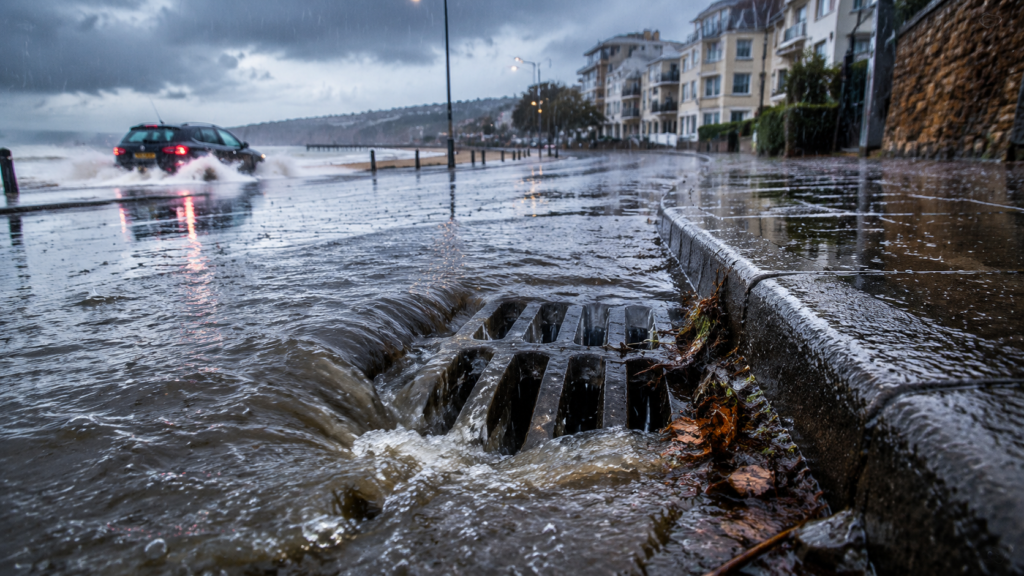
If you’ve lived in Bournemouth for more than a couple of winters, you’ll know the pattern. A long, dry spell followed by a sudden downpour, and within an hour the road gullies are bubbling, the patio drain is overflowing, and the soakaway in the back garden has turned into a small pond. Then come the news reports of storm overflows discharging into the Stour or Avon, and the social media posts asking why, exactly, this keeps happening in 2026.
The honest answer is that Bournemouth’s drainage system is doing a hard job in a town that wasn’t designed for the way it now rains. Cliffs, chines, sandy soils, an ageing combined sewer in older neighbourhoods, a tourist population that swells in summer, and rainfall patterns that have shifted toward heavier, less frequent storms, all of it lands on the same set of pipes and pumps when the heavens open.
At Drainage Care Solutions, we deal with the local fallout every single storm season. This guide explains exactly how heavy rainfall affects drainage in Bournemouth, why some properties suffer more than others, and what you can do about it, from preventative steps before the next downpour to what to do if water is already backing up.
Just How Much Rain Does Bournemouth Get?
Bournemouth has a reputation as one of the drier corners of the UK, and the long-term Met Office data backs that up, but only just. According to Met Office records for Bournemouth Airport (1991–2020 averages), the town receives around 790 mm of rainfall per year, with November typically the wettest month and July the driest.
That sounds manageable on paper. The problem isn’t the annual total, it’s how the rain arrives.
Across the UK, climate scientists and water companies have been flagging the same shift for years: rainfall is becoming less frequent but far more intense. Long dry spells bake the ground hard, leaves and silt pile up in gullies, and then a single afternoon’s downpour delivers what used to fall over a fortnight. River Action UK has summarised the issue bluntly: the system was built for a different climate, for lighter, steadier rain and now has to handle huge downpours after long dry spells.
In a town like Bournemouth, where steep gradients, ageing infrastructure and coastal geography are already working hard, that shift hits especially fast.
Why Bournemouth’s Geography Makes Heavy Rain Worse
Bournemouth isn’t a flat town. It’s built around cliffs, valleys (the chines) and steep coastal roads that funnel water in predictable but punishing ways.
When intense rain falls on East Cliff, West Cliff, Southbourne or any of the high ground above the seafront, gravity goes to work immediately. Water races downhill through road gullies, surface water drains and the natural routes carved by the chines, Alum Chine, Durley Chine, Middle Chine, Boscombe Chine and others, heading for the sea. The further down the hill you live, the more water from higher properties passes by your drainage on its way past.
That has three practical consequences for homeowners:
- Lower-lying properties take a hammering. Houses near the bottom of slopes, at the foot of chines, or close to the promenade often receive surface water from streets and gardens further uphill. A perfectly sized drain on a flat street wouldn’t be sized for that load here.
- Pumping stations matter more than people realise. Because gravity can only get sewage and surface water so far down the hill, parts of the town rely on pumping stations to lift wastewater back into the main network. When intense rain overwhelms a pumping station, or knocks out the power to it, flooding spreads quickly.
- Older drains struggle with the surges. Many Bournemouth properties built between the 1950s and 1970s still have original pitch fibre drainage, while Victorian homes in Boscombe and surrounding areas commonly have aged clay pipework. Both can handle steady flow, but cracks, displaced joints and silt build-up mean they aren’t sealed to handle sudden high-pressure surges from heavy rain.
How Heavy Rain Affects the Wider Bournemouth Sewer Network
Most of Bournemouth’s wastewater is taken to the Holdenhurst Water Recycling Centre, operated by Wessex Water. The site includes a large storm tank capable of holding nine million litres of excess flow, extra storage designed specifically to buffer the system during heavy rain so that excess flow can be treated later rather than overwhelming the works in real time.
That helps. But it doesn’t solve the underlying issue, which is the Combined Sewer Overflow (CSO) design used across most of the UK and much of Dorset.
In a combined sewer system, foul wastewater (toilets, sinks, showers) and surface water (rain from roads and roofs) travel in the same pipes. On a normal day, the network handles both with no trouble. After two days of heavy rain, the volume of stormwater entering those same pipes climbs so steeply that the network can be pushed past its safe capacity in hours.
When that happens, storm overflows activate. These are deliberate relief points designed to prevent untreated sewage backing up into homes and streets, but their consequence is that diluted wastewater gets released into rivers like the Avon, Stour and Piddle, or into the sea. Local reporting confirms this is exactly what happened across Dorset after recent two-day downpours, with discharges affecting waterways from the Iford playing fields outflow into the Avon onwards.
For homeowners, the message is sobering: the system is designed to overflow before it backs up into your house, but that protection only works if your own private drainage is in good condition. Once the public network is at capacity, anything wrong on your side of the boundary becomes a flood risk fast.
Surface Water Outfalls Are Not the Same as Sewage Outfalls
One important point worth clearing up, especially for residents near the beaches: not every outfall you see discharging after heavy rain is sewage.
A foul sewer carries wastewater from toilets, sinks, showers and washing machines to treatment. A surface water drain carries rainwater from roofs, roads, gullies and paved areas, typically straight to a stream, river or the sea. Public information for Boscombe Beach, for example, confirms that rainwater from areas including East Cliff and Springbourne travels via the surface water system to a beach outfall.
Surface water isn’t supposed to contain sewage. But after a heavy storm, it picks up oil from roads, litter, cigarette ends, dog waste, silt, leaves and other pollutants on its way to the outfall, which is why discharge from a surface water outlet can still look unpleasant even when no sewage is involved.
There is one exception that matters for property owners: misconnections. If a washing machine, dishwasher, toilet or kitchen sink has been wrongly plumbed into the surface water system rather than the foul sewer, common in older properties, converted flats and badly-done extensions, then wastewater from your home is travelling untreated to a river or beach every time you run it. A CCTV drain survey is the only reliable way to confirm where your drains actually go.
What Heavy Rainfall Does to Your Property’s Drainage
Set aside the wider network for a moment and look at what’s happening on your side of the boundary. Heavy rainfall causes a predictable set of problems for individual Bournemouth properties:
1. Blocked drains turn from inconvenient to urgent
A partially blocked drain that’s been slowing down for weeks may handle daily use fine, but it won’t cope with a sudden 20-fold surge in flow during a storm. The result is overflow at the gully, back-up into ground-floor wet rooms, or water finding its way under doors. If your sinks have been gurgling, your toilets slow to clear, or there’s a faint smell near outside gullies, the next big storm is when those warnings become emergencies. Our blocked drains team attends storm-triggered blockages across Bournemouth most weeks during autumn and winter.
2. Hidden pipe damage becomes obvious
Cracks, displaced joints, root ingress and pitch fibre deformities sit harmlessly under steady flow but fail under pressure. Heavy rain forces water through any weakness in the system, sometimes washing soil into the pipe (causing future blockages) and sometimes washing soil out from around it (causing future collapses). If a previously clear drain suddenly starts misbehaving after a storm, the damage probably existed already, the rain just exposed it.
3. Soakaways fail and Bournemouth soakaways fail in their own way
This is where local geology really matters. Much of the Bournemouth area sits on sandy soils linked to the Poole and Branksome formations, generally good for infiltration, which is why traditional soakaways have been so common here. But sandy soils have their own failure mode: over the years, the surrounding ground gradually silts up the soakaway from the outside in, and the void volume shrinks. The soakaway may have worked perfectly for two decades, then suddenly seem to “fail” during a single heavy storm.
The classic signs are standing water on the lawn for hours or days after rain, a soggy patch directly over the soakaway, water backing up at the rainwater downpipe, or a previously dry garden flooding for the first time. If any of that sounds familiar, the soakaway hasn’t broken overnight, it’s reached the end of its useful life, which a soakaway assessment and replacement can confirm and resolve, often with a modern crate system that handles much higher volumes.
4. Collapsed drains and emergency damage
Saturated ground around a pipe is heavier ground, and a heavy storm can be the final straw for a drain that was already cracked or partially collapsed. We get a noticeable spike in emergency drain repair call-outs in the 48 hours after major rainfall, usually properties where a smaller issue had been quietly developing for months. The good news is that modern no-dig drain lining and patch repair techniques mean most storm-related collapses can be fixed without excavating gardens or driveways.
5. Surface water flooding around the property
Even when the drains are working perfectly, your driveway, garden and patio can flood if surface water has nowhere to go, typically because gullies are blocked with leaves, channel drains are silted, or paved areas have been added without permeable drainage. This is the kind of flooding that homeowners can do most about themselves between storms.
Which Bournemouth Properties Suffer Most?
Through years of attending storm call-outs across Boscombe, Westbourne, Southbourne, Charminster, Winton, Moordown, Kinson and beyond, certain property types consistently struggle more:
- Victorian terraces in Boscombe and central Bournemouth: Original clay pipework that has shifted and cracked over a century in the ground
- 1950s–1970s semis in Moordown, Wallisdown and Kinson: Pitch fibre drainage that has deformed, blistered or collapsed
- Coastal flats and clifftop properties: Relying on pumping stations and long runs of pipe down to the wider network
- Properties at the foot of chines or slopes: Taking surface water flow from streets and gardens above
- Older properties with extensions: Extra bedrooms and bathrooms added without upgrading the original drain runs
- Homes with mature gardens or tree-lined roads: Root ingress is one of the most common causes of storm-revealed damage
If you live in any of these and you’ve had previous drainage problems, the best time to investigate is before the next heavy rain, not during it.
What Bournemouth Homeowners Can Do Before the Next Storm
You can’t change the weather, the geography, or the age of the public sewer network. You can change the condition of your own drainage. A few practical steps go a long way:
- Clear gullies, gratings and channel drains of leaves and silt. This is the single highest-value 15-minute job most homeowners can do before autumn.
- Check your downpipes and rainwater goods. Blocked gutters and downpipes deliver rainwater to the wrong places, including against the side of the house.
- Test the soakaway. After moderate rain, water shouldn’t be sitting on the lawn above your soakaway for hours. If it is, the system is full or failing.
- Don’t pave over without drainage. New patios, driveways and extensions need to be properly drained, usually permeable surfaces or connection to surface water drainage. Adding impermeable hardscape without addressing drainage is a leading cause of storm flooding around homes.
- Investigate persistent warning signs. Slow drainage, gurgling toilets, recurring blockages, bad smells, damp ground near inspection chambers, or water backing up, any of these is a warning that becomes a flood risk in a storm. A CCTV drain survey identifies exactly what’s happening and what (if anything) needs fixing.
- Avoid pouring fats, oils, wipes or sanitary products down drains. Grease build-up and “fatbergs” are major causes of blockages that fail spectacularly during heavy rain. This is true year-round but it’s the difference between a minor inconvenience and a flooded kitchen in November.
What to Do During and After Heavy Rainfall
If a storm is already underway and water is backing up:
- Stop using water inside the property: No flushing, no washing machines, no showers. You’re adding to a system that can’t take it.
- Move valuables off the floor: In any room with a gully or floor drain.
- Don’t try to clear the blockage with chemicals: Drain cleaners on a backed-up system can splash, damage pipes and make the eventual professional clean-up harder.
- Take photos of the flooding: For insurance purposes, including the source if you can identify it.
- Call a drainage engineer: The earlier in the event you get help on the way, the smaller the damage. Drainage Care Solutions attends drainage emergencies across Bournemouth on the same day, day or night.
Once the rain stops, the work isn’t over. Storms expose problems that may not be obvious immediately. If you’ve had any backing-up, slow drainage, gurgling, or unexpected pooling during the storm, even if everything seems to have cleared by morning, it’s worth getting the system checked. The damage that caused the problem hasn’t gone anywhere; the rain just stopped showing you it.
When to Call a Professional
You should book a professional drainage check after heavy rain if:
- Drains backed up or overflowed at any point during the storm
- Sinks, toilets or showers were slow to drain afterwards
- You noticed gurgling sounds, bad smells or unusual water levels in inspection chambers
- Water pooled in the garden, especially over the soakaway area
- It’s the second or third time you’ve had storm-related drainage problems
- You’ve never had a CCTV survey done and the property is more than 30 years old
Honest assessment from a qualified engineer is far cheaper than a flooded ground floor. At Drainage Care Solutions, we don’t charge for diagnostic guesswork, we use CCTV drain surveys to show you exactly what’s happening below ground, explain the findings in plain English, and only recommend work that’s actually needed.
A Local System Under Local Pressure
Bournemouth’s drainage will keep being tested. The town’s geography hasn’t changed, the rainfall pattern is trending toward more intense storms, and most of the underground infrastructure was designed for a smaller population and a gentler climate. Public investment in storm storage and treatment is helping, but the network can only do its job if private drains feeding into it are also in good order.
That’s where homeowners have real control. A clear gully, a healthy soakaway, a CCTV-surveyed drain run with no hidden cracks, these are the things that decide whether a heavy autumn night is uneventful or expensive.
If you’re noticing the early signs of drainage trouble, or you’ve already had problems during a recent storm, contact Drainage Care Solutions or call 07717 561588. We’re locally based, we know Bournemouth’s drainage from Boscombe to Kinson, and we’ll give you an honest assessment before any work begins.
Frequently Asked Questions
Why do drains overflow during heavy rain in Bournemouth?
Most older parts of Bournemouth use a Combined Sewer Overflow (CSO) system that carries foul wastewater and rainwater in the same pipes. During heavy rain, the volume can exceed network capacity, causing storm overflows to release diluted wastewater to rivers or the sea. On individual properties, blocked gullies, failed soakaways, root-damaged pipes and cracked drains can all cause local flooding under the same conditions.
Does sewage really discharge into Dorset rivers and the sea after heavy rain?
Yes. After significant rainfall, storm overflows operated by Wessex Water can discharge diluted sewage into the Avon, Stour, Piddle and other waterways as a designed relief mechanism to prevent backing up into homes. Surface water outfalls also discharge rainwater that has picked up road pollutants. Live discharge data is publicly available through sources like sewagemap.co.uk.
My soakaway worked fine for 20 years and suddenly floods, what changed?
Soakaways in Bournemouth’s sandy soils typically work well for many years, then “fail” relatively suddenly as the surrounding ground silts up and the soakaway’s effective void volume shrinks. Often a single heavy storm is what makes the failure obvious. A professional infiltration test confirms whether the soakaway needs cleaning, partial repair or full replacement.
Who is responsible for a blocked drain after a storm, me or the water company?
If the blocked drain sits entirely within your property boundary and only serves your property, it’s generally your responsibility as the homeowner. Shared drains serving multiple properties are typically the water company’s responsibility (Wessex Water in this area). Landlords have separate legal obligations under the Landlord and Tenant Act to maintain drainage in rental properties. If you’re unsure where the boundary sits, a drainage engineer can clarify before any work begins.
Is storm-related drain damage covered by home insurance?
Some policies cover accidental damage to drains and storm-related repairs, but cover varies significantly between insurers, and blockages from grease, roots or general wear are usually excluded. Check your policy wording carefully. We can provide a written CCTV survey report that insurers often request as supporting evidence.
Can a damaged drain be repaired without digging up my garden?
In most cases, yes. No-dig drain lining and patch repair techniques restore cracked or fractured pipes from inside the pipe, without excavation. A CCTV survey confirms whether the damage is suitable for no-dig repair, which is significantly less disruptive and is our preferred method whenever pipe condition allows.
How quickly can Drainage Care Solutions attend an emergency after a storm?
We aim to attend drainage emergencies across Bournemouth on the same day you call, day or night. Collapsed drains, backed-up properties and active flooding are prioritised over routine bookings.