Every winter, the same thing happens in gardens across Bournemouth. The rain comes down, and instead of soaking away, it pools on the lawn, sits against the patio, and turns a perfectly good garden into a bog. Most homeowners assume it’s just bad luck with the weather. More often than not, it’s a soakaway that has stopped doing its job — or was never built properly in the first place.
If you’ve started looking into soakaway installations in Bournemouth, you’ve probably noticed that nobody really explains what these systems are actually made of. That matters because the materials decide whether your soakaway lasts five years or fifty. Having installed and replaced these systems right across the BH postcodes, the team at Drainage Care Solutions has seen exactly what works in our local ground — and what fails far too soon.
First, What Is a Soakaway Actually Doing?
A soakaway is a structure buried in your garden that collects surface water — rain from your roof, driveway or patio — and lets it drain slowly into the surrounding soil rather than flooding the surface or overloading the public sewer. It’s a key part of any sensible surface water drainage setup, and on many newer properties it’s a requirement under Building Regulations Approved Document H. The modern version looks nothing like the soakaways built decades ago. And the difference comes down entirely to the materials.
The Materials That Make Up a Modern Soakaway
A well-built modern soakaway is essentially a layered system, with each component doing a specific job. Here’s what goes into one.
Geocellular Soakaway Crates
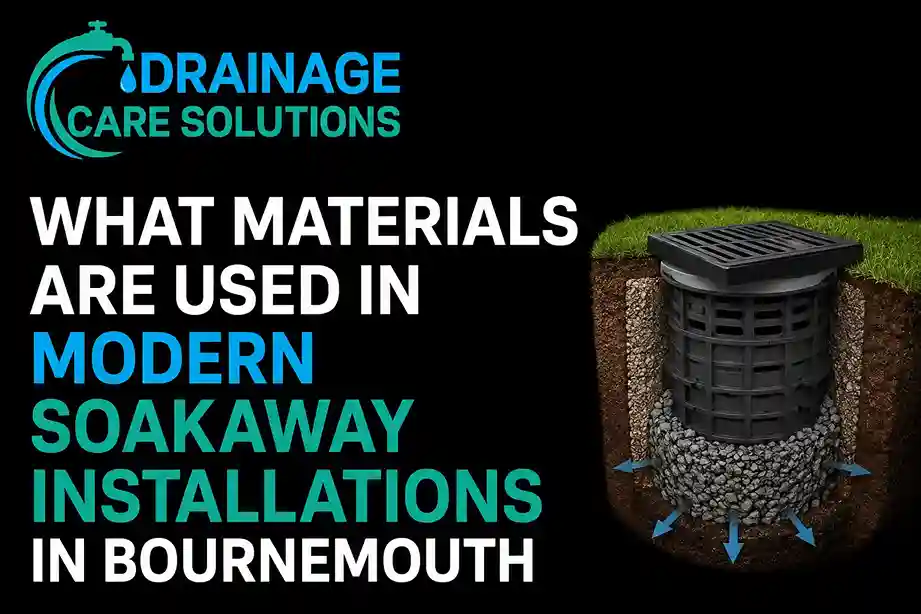
The heart of nearly every modern installation is the soakaway crate — sometimes called a geocellular or attenuation crate. These are strong, modular plastic units, a bit like sturdy hollow boxes, that clip together to form a chamber underground. Their advantage is space. An old rubble pit might offer 30% void space for water to fill, whereas crates offer around 90–95%. That means a crate system holds far more water in a far smaller hole — a real benefit in compact Bournemouth gardens where you can’t dig up half the lawn. They’re also designed to bear loads, so they can sit beneath a lawn or, with the right specification, even a driveway.
Geotextile Membrane
Wrapped around the entire crate assembly is a geotextile membrane — a permeable fabric that’s one of the most important materials in the whole system. It lets water pass through into the soil but stops silt, soil and fine debris from washing into the crates and clogging them up. Skip this layer, or use a cheap one, and the soakaway slowly silts up from the outside in. In our experience, a failed membrane is one of the most common reasons a soakaway that’s only a few years old stops draining.
Granular Backfill — Shingle and Gravel
Around the wrapped crates goes a layer of clean granular backfill, usually shingle or gravel aggregate. This serves two purposes: it protects the crates during backfilling and creates a buffer zone that helps water disperse evenly into the surrounding ground. The stone must be clean and free of fines; it defeats the point and chokes the system.
Perforated Pipework
Water reaches the soakaway through a perforated pipe — a drainage pipe with slots or holes that allow water to enter and exit along its length. This connects your downpipes, channel drains or surface gullies to the crate chamber, carrying collected rainwater to where it can soak away safely. On most soakaway installations in Bournemouth, this pipework is laid to a slight fall so gravity does the work, moving surface water steadily towards the crates.
Inspection Chamber and Silt Trap
A properly specified installation usually includes an inspection chamber and, ideally, a silt trap or catchpit before the water reaches the crates. The silt trap catches grit and debris early, which dramatically extends the system’s lifespan. The inspection point lets an engineer check and maintain the soakaway over the years — something the old buried-rubble approach never allowed.
Why Modern Crates Beat the Old Rubble-Filled Pit
For decades, a soakaway was simply a hole filled with broken brick, rubble or large stones. It worked, after a fashion. But the void space was small, the gaps clogged with silt over time, and once it failed there was no way to inspect or maintain it — you just dug a new one.
Modern crate systems hold more water, last longer, can be inspected, and take up less of your garden. If you’re replacing an old soakaway in Boscombe or Winton, this is almost always the upgrade we recommend. You can read more about our full soakaway repair and replacement service for the details.
The Bournemouth Factor: Why Local Soil Changes Everything
Here’s where local knowledge earns its keep. Bournemouth sits on largely sandy, free-draining soil, which is generally good news for soakaways — water disperses readily. But “generally good” isn’t a guarantee. Pockets of clay, a high water table, or compacted ground can all stop a soakaway working no matter how good the materials are.
That’s why no reputable installer should ever fit a soakaway without first carrying out a percolation test. We use the BRE 365 method — the recognised industry standard for soakaway design — which measures how quickly water actually drains away in your ground. The results determine the size of the crate chamber you need. Get this wrong, and even the best materials will flood.
How the Materials Come Together on Site
In practice, a typical installation follows a clear sequence:
- Percolation test: An engineer carries out a BRE 365 test to measure how quickly water drains through the ground.
- Volume calculation: The results determine the size of the crate chamber your property actually needs.
- Excavation: The hole is dug to the correct depth, usually at least five metres from any building.
- Crate assembly: The geocellular crates are clipped together to form the chamber.
- Membrane wrap: The whole assembly is fully wrapped in a geotextile membrane to keep silt out.
- Pipe connection: The perforated pipework is connected to carry surface water into the crates.
- Backfill: Clean granular backfill (shingle or gravel) is packed around the membrane-wrapped crates.
- Cover over: The system is backfilled and the surface reinstated.
A standard domestic soakaway in Bournemouth’s sandy conditions takes around a day to install once the assessment is done.
How Long Should a Modern Soakaway Last?
A correctly designed and installed crate soakaway, fitted with a quality membrane and a silt trap, should comfortably last 20 to 30 years or more with minimal maintenance. The systems that fail early almost always do so because of one of three things: no percolation test, a poor or missing membrane, or undersized crates. All three are avoidable — they come down to doing the job properly rather than cheaply.
Get It Done Right the First Time
Soakaways aren’t complicated, but they are unforgiving of shortcuts. The materials matter, the soil test matters, and the experience of the person fitting it matters most of all. Every engineer at Drainage Care Solutions is qualified, fully insured, and knows exactly how the Bournemouth ground behaves. If your garden floods, your existing soakaway has given up, or you’re planning a new installation, get in touch for a free, no-obligation quote. We’ll test your ground, recommend the right system, and explain every part of it in plain English — no jargon, no hidden charges.
Common Questions Soakaway Installations in Bournemouth
What materials are used in a modern soakaway?
Modern soakaways use geocellular plastic crates wrapped in a geotextile membrane, surrounded by clean shingle or gravel backfill. Perforated pipework feeds water in, and a silt trap or inspection chamber helps keep the system maintainable.
Are plastic soakaway crates better than a rubble-filled pit?
Yes, in almost every case. Crates hold far more water (around 90–95% void space versus roughly 30% for rubble), last longer, and can be inspected and maintained — something an old rubble pit never allowed.
Do I need a percolation test before installing a soakaway in Bournemouth?
Yes. A BRE 365 percolation test measures how quickly water drains in your specific ground. Even on Bournemouth’s sandy soil, this is essential for sizing the system correctly and avoiding future flooding.
How long does a soakaway installation take?
A standard domestic soakaway in Bournemouth usually takes around one full working day to install once the ground assessment is complete. Larger systems or restricted access can take a little longer.
How long does a modern soakaway last?
A well-designed crate soakaway with quality membrane and a silt trap should last 20 to 30 years or more. Early failures are almost always down to a missing membrane, no percolation test, or undersized crates.