A slow-draining sink. A faint, lingering smell near the back door. A small crack above a window you’ve been meaning to fill in for months. On their own, none of these feel urgent. Together, though, they can be the early warning signs of something far more serious, drain damage that is quietly undermining the structural integrity of your home.
Most homeowners think of drains as a plumbing issue. In reality, your underground drainage system sits in direct contact with the soil supporting your property. When it fails, the consequences don’t stop at slow water flow. According to the Association of British Insurers (ABI), domestic subsidence claims reached £153 million in the first half of 2025 alone, supporting nearly 9,000 households, and in a typical year, roughly 18% of all subsidence claims are caused by leaking drains and water supply pipes. That makes damaged drainage one of the single biggest hidden threats to UK homes.
This guide from our team at Drainage Care Solutions explains exactly how drain damage leads to structural problems, the warning signs every homeowner in Bournemouth should know, and what to do if you spot them.
Drain Damage Is Not Just a Plumbing Problem
Your drainage system runs beneath patios, driveways, gardens and crucially, beneath or alongside the foundations of your home. Pipes carry waste water away under pressure, and they’re designed to be entirely watertight. The moment that integrity is broken, even by a hairline crack or a displaced joint, water begins to escape into the surrounding ground.
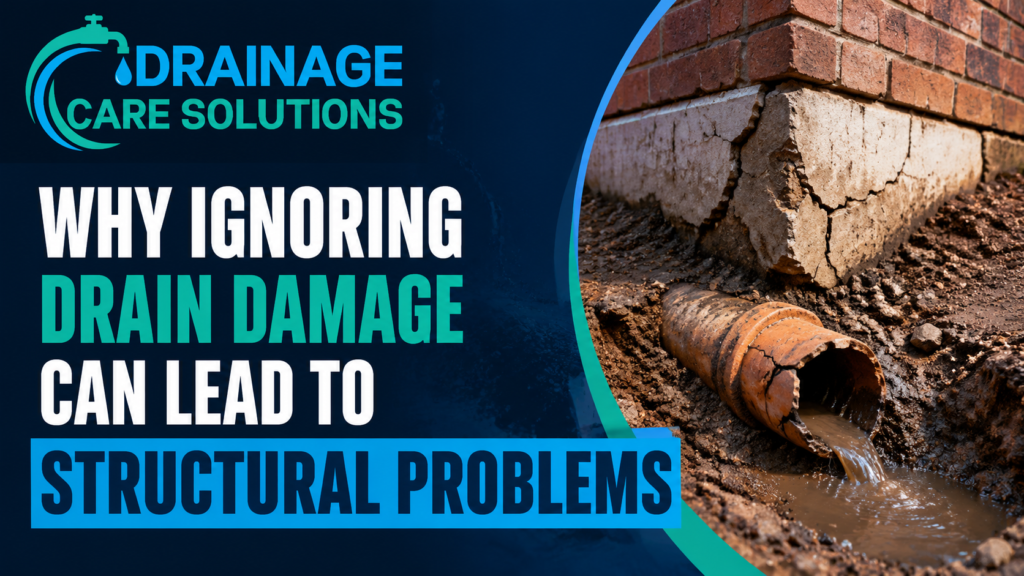
This is the point at which a “plumbing problem” stops being a plumbing problem and becomes a structural one. Water doesn’t just disappear into the soil. It softens it, washes parts of it away, and changes the way the ground supports the weight of the building above. Months or years of unnoticed leakage can quietly create the conditions for cracks, sinking floors, and in serious cases, subsidence.
How Damaged Drains Cause Structural Problems
Drain damage causes structural issues in several different ways, often at the same time. Understanding the mechanism makes it much easier to see why early action matters so much.
1. Water Seepage Weakens Foundations
When a drain leaks, water escapes continually into the soil immediately surrounding it. That soil expands as it absorbs moisture and contracts as it dries, a constant push-pull cycle that puts stress on anything buried within it, including foundation walls. Over time, this expansion and contraction can crack, render, separate joints, and shift load-bearing footings out of alignment.
Cracks then appear in walls inside and outside the home, often radiating from the corners of windows and doors where the stress concentrates first.
2. Soil Erosion and Voids Beneath the Property
A leaking drain doesn’t only soften the ground, it can actively wash it away. Fine particles of sand and silt are carried into the broken pipe each time water flows past, gradually hollowing out the soil that surrounds it. Eventually, this creates voids: pockets of empty space beneath the surface where solid ground used to be.
If those voids form under a driveway, you’ll see it sinking. If they form near or under the building, the foundations lose support and the structure begins to move. This is one of the most common drainage-related causes of subsidence, and it can happen entirely silently for years before any visible sign appears.
3. Subsidence
Subsidence, the downward movement of the ground beneath a building, is the most serious structural consequence of drain damage, and it’s far more common than many homeowners realise. The ABI estimates that more than 5.76 million UK properties sit in areas with medium to high subsidence risk, and over a million of those are thought to face increased risk specifically because of defective or leaking clay drains and water supply pipes.
When subsidence takes hold, you typically see sudden, diagonal cracks (wider at the top than the bottom), doors and windows that suddenly stick, sloping floors, and gaps appearing between skirting boards and walls. These cracks usually appear quickly rather than gradually, which is one of the things that distinguishes subsidence damage from normal settlement.
4. Pressure Build-Up and Pipe Collapse
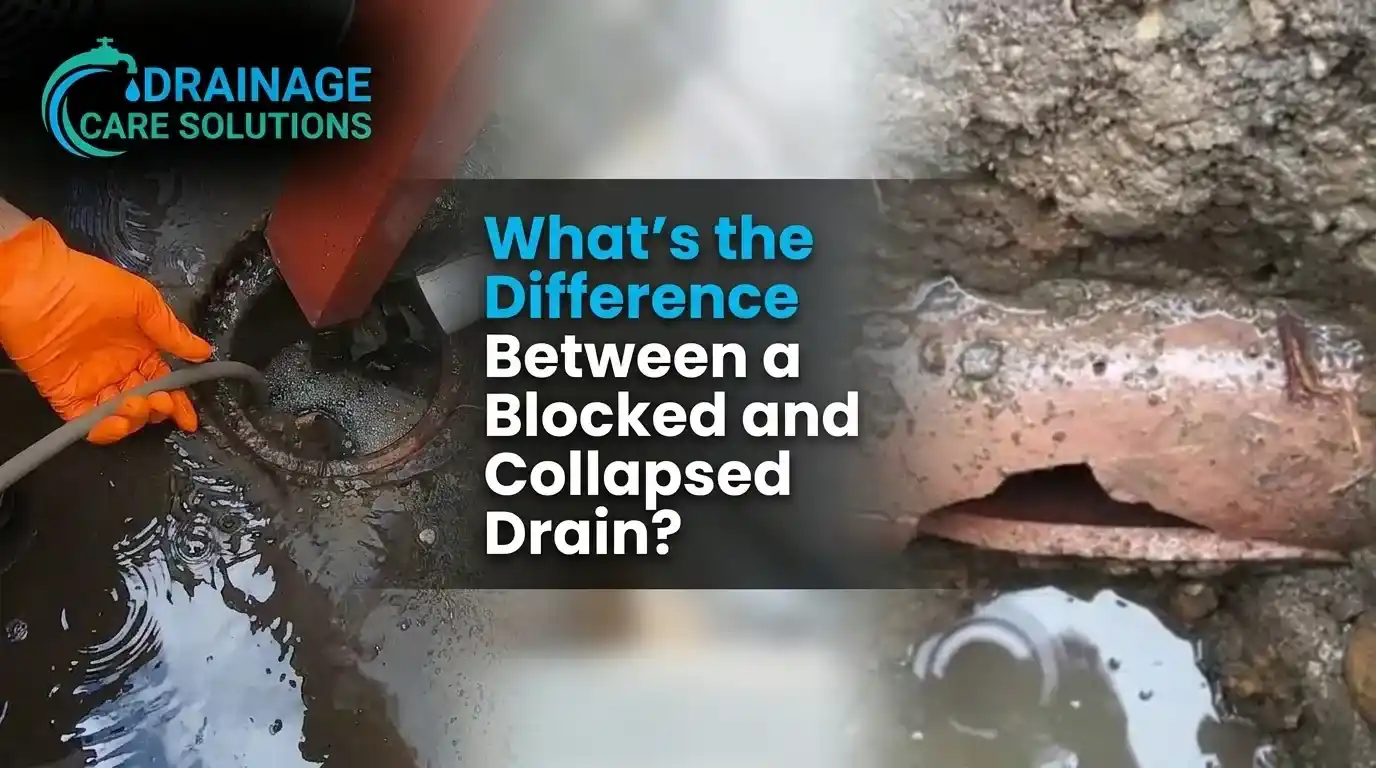
A blocked drain doesn’t sit still. Water and waste continue to push against the obstruction, and the resulting pressure has to go somewhere. Over weeks or months, that pressure stresses the pipe wall itself, causing joints to separate, cracks to widen, and in older clay or pitch fibre systems, sections of pipe to deform or collapse entirely.
Once a section collapses, the problem accelerates. Soil pours into the pipe through the breach, the void above grows, and what started as a slow-draining sink becomes a full structural emergency requiring emergency drain repair.
5. Damp, Mould and Wall Rot
Leaking drains release moisture into the ground directly below or beside the building. That moisture rises through brickwork by capillary action, defeating damp-proof courses that were never designed to hold back a constant water source. The result is persistent damp patches on internal walls, peeling wallpaper, blown plaster, musty smells that won’t lift, and over time, the rotting of timber floors, joists, and skirting.
This kind of damp doesn’t respond to dehumidifiers or decorative repairs because the source is buried outside the house. Until the drain is fixed, the damp keeps coming back.
6. Sinking Gardens, Patios and Driveways
You don’t have to wait for cracks inside the house to spot drainage-related structural damage. Sunken patches in the lawn, dipped sections of patio, paving slabs that have started to tilt, and driveways with unexplained depressions are all classic signs of soil washing into a damaged drain or failed soakaway below. Where this water is meant to disperse into the ground through a soakaway system, a collapsed or saturated soakaway will leave the garden boggy after every shower of rain.
Warning Signs Your Drains May Be Damaging Your Home
The earlier you catch the symptoms, the less likely you are to deal with a structural problem. Watch for these warning signs:
- Persistently slow drainage in sinks, baths, or toilets, especially if more than one fixture is affected
- Gurgling sounds from plugholes or toilets when water is flowing somewhere else in the house
- Unpleasant or sewage-like odours around plug holes, outside gullies, or in the garden
- Damp patches on internal walls or floors that resist normal damp treatment
- Cracks in walls, particularly diagonal cracks around window or door corners, or cracks wider than 3 mm
- Doors and windows that suddenly stick in their frames without obvious cause
- Wallpaper rippling or rucking, or gaps opening between skirting boards and walls
- Sunken or dipped patches in the lawn, driveway, or patio
- Unusually green or lush patches of grass, which can indicate leaking foul water below
- Standing water in the garden that doesn’t drain away after rain
- Repeated blockages in the same pipe run, even after clearing
Any single one of these can be innocent. Several appearing together, or one recurring after being “fixed”, is a strong signal that something deeper is going on and that signal usually points to your drainage system.
What Causes Drain Damage in the First Place?
Knowing how drains end up failing helps explain why structural risk builds up so quietly. The most common causes we see across Bournemouth properties are:
Tree root intrusion. Roots are drawn to the moisture and nutrients inside drainage pipes. They enter through tiny gaps in joints, expand inside the pipe, and crack or block it from within.
Ageing pipework. Older clay drains, common in Victorian and Edwardian terraces in Boscombe, Westbourne and Southbourne, can shift, crack, and lose alignment over decades.
Pitch fibre deformation. Many Bournemouth properties built between the 1950s and 1970s have pitch fibre drainage that deforms over time, collapsing inwards and restricting flow. Recognising pitch fibre on sight is essential because it needs a specific repair approach.
Ground movement. Natural soil shifts, particularly during the kind of hot, dry summers the UK has seen in recent years, can crack pipes or pull joints apart.
Poor installation or DIY repairs. Misaligned joints, unsupported pipes, or temporary fixes from earlier work create weak points that fail under normal use.
Internal blockages. Fat, oil, wipes, sanitary products, and other debris build up over time. Once a blockage forms, pressure builds up behind it and accelerates damage to the pipe.
Failed soakaways. In sandy Bournemouth soils, older soakaways can saturate, clog, or collapse, sending surface water back towards the house rather than dispersing safely into the ground.
Why Bournemouth Properties Are Particularly Vulnerable
Bournemouth’s combination of property age and soil type creates specific drainage risks that homeowners elsewhere might not face. The sandy soil that covers much of the BH postcode area drains well, but it’s also easily eroded, meaning a small leak can wash significant volumes of fine material into the pipe over time, accelerating both pipe damage and the formation of voids beneath the property.
Add to that the high proportion of Victorian clay pipework still in service across Boscombe and Charminster, and the pitch fibre installations that are now reaching the end of their realistic working life in 1950s–1970s semis in Moordown, Wallisdown and Kinson, and the picture is clear: a meaningful number of local homes are sitting on drainage systems that are statistically more likely to be approaching failure.
That’s not a reason to panic, it’s a reason to inspect. A professional CCTV drain survey reveals the exact condition of the pipework beneath your property in a couple of hours, with no excavation involved.
What To Do If You Suspect Drain-Related Structural Damage
If you’ve recognised any of the warning signs above, take it seriously, but don’t panic. Here’s the right order of action.
1. Stop using affected fixtures where possible. If water is backing up or pooling, reducing flow into the system prevents further damage while you arrange an inspection.
2. Don’t use chemical drain cleaners. Aggressive chemicals can corrode older clay and pitch fibre pipework, making structural damage worse, and they rarely solve the underlying problem. They also pose a safety risk in confined spaces.
3. Book a CCTV drain survey. This is the single most important step. A camera inspection traces the pipework, identifies cracks, root intrusion, displaced joints, collapses, and pitch fibre deformation, and produces a written report with footage references. It tells you exactly what’s wrong before any digging or repair work is even considered.
4. Address blockages properly. If a blockage is identified, high-pressure water jetting clears it without damaging the pipe walls and removes any built-up grease, silt, or root mass that could cause it to recur.
5. Repair using no-dig methods where suitable. Many drain repairs no longer require excavating your garden or driveway. Patch lining and full pipe relining restore cracked or fractured pipes from the inside using a cured resin liner, significantly less disruptive than traditional dig-and-replace work, and almost always faster. The CCTV survey confirms whether the pipe condition and location allow for no-dig repair.
6. Don’t ignore an emergency. A collapsed drain, sudden sinkhole, or water backing up into the house is a same-day issue. Our emergency drain repair team attends across Bournemouth, Poole, Christchurch and the wider BH postcode area for exactly these situations.
Preventing Drain Damage Before It Becomes Structural
Prevention is dramatically less disruptive than dealing with subsidence repair work, and a handful of habits make a real difference.
Inspect periodically. A CCTV survey every few years, and any time you notice persistent slow drainage or odours, catches small issues long before they become structural.
Get a homebuyer drain survey. If you’re buying an older property anywhere in Bournemouth, a pre-purchase CCTV survey is one of the most useful checks you can carry out. It can also be used in negotiations with the vendor if problems are found.
Watch what goes down your drains. Fats, oils, wipes (including “flushable” ones), nappies, and sanitary products are the single biggest cause of avoidable internal blockages.
Look after your soakaway. If your garden floods after heavy rain, your soakaway may need testing and replacement. A proper soakaway assessment prevents surface water from backing up towards the house.
Don’t ignore the early signs. Slow drainage, smells, and gurgling are almost always cheaper to investigate than to live with. They rarely improve on their own.
When to Call a Professional
Call a qualified drainage engineer when you see any of the following: repeated blockages in the same pipe, persistent odours, slow drainage across multiple fixtures, water pooling in the garden or driveway, sinking lawns or patios, sudden cracks indoors, doors or windows that have started to stick, or any sign of damp that doesn’t respond to normal treatment. The earlier these are investigated, the more options you have, and the less invasive the repair tends to be.
At Drainage Care Solutions, we cover Bournemouth, Poole, Christchurch, and every BH postcode district. Every engineer carries high-pressure jetting equipment and a CCTV survey camera, so in most cases we can diagnose and resolve the problem in a single visit. We work on every type of drainage system common to local properties, from Victorian clay to pitch fibre to modern plastic and we explain exactly what we’ve found before any tools come out.
If you’ve noticed something that doesn’t feel right, get in touch with our teamfor honest, no-pressure advice. Same-day attendance is available across Bournemouth.
Frequently Asked Questions
Can a blocked drain really cause subsidence?
Yes. While the majority of subsidence cases in the UK are caused by clay shrinkage and tree roots, around 18% of all subsidence claims are linked to leaking drains and water supply pipes, making damaged drainage one of the most significant single causes of structural ground movement in UK homes.
How do I know if cracks in my walls are caused by drainage?
Drainage-related cracks tend to appear suddenly rather than gradually, are often diagonal, wider at the top than the bottom, and frequently radiate from the corners of windows or doors.
Can drains be repaired without digging up my garden?
In many cases, yes. No-dig drain lining and patch repair restore cracked or fractured pipes from the inside without excavation, provided the pipe condition and location allow it.
How long does a CCTV drain survey take?
A standard domestic CCTV drain survey typically takes between 45 minutes and two hours, depending on how many drain runs need inspecting. You receive a written report with the camera footage referenced for permanent record.
Is drain damage covered by home insurance?
It depends on the policy. Many policies cover accidental damage to drain pipes and resulting structural damage, but routine wear, gradual deterioration, and general blockages are typically excluded. Check your policy wording carefully. A written drainage report is often required as evidence when making a claim.
Who is responsible for fixing a damaged drain?
If the drain serves only your property and sits within your boundary, responsibility generally falls to you as the homeowner. Drains shared between multiple properties are usually the responsibility of the water company (Wessex Water in much of the Bournemouth area).
How often should drains be inspected?
There’s no fixed rule, but a CCTV inspection every few years is sensible for older properties, particularly those with original clay or pitch fibre drainage. Inspection becomes urgent the moment you notice persistent slow drainage, odours, gurgling, or any of the structural warning signs covered above.
Will a damaged drain get worse if I do nothing?
Almost always, yes. Damaged drains do not heal themselves. Cracks widen, root intrusion grows, soil erosion continues, and small structural movements compound. The longer the underlying drainage problem is left, the more invasive the eventual repair tends to be and the greater the risk to the property’s structure.