Drainage problems in Bournemouth homes rarely appear without warning. In most cases, the system gives you clear signals days or even weeks before a full blockage develops. The difficulty is that many homeowners either dismiss these early signs or attempt a temporary fix that does not address the underlying cause. Understanding what your drains are telling you, and knowing when to call a qualified engineer, can protect your property from serious structural damage and prevent the kind of disruption that a full drainage emergency brings.
This guide covers every key warning sign that a Bournemouth property is overdue for professional drain unblocking, along with the specific local factors that make drainage issues here different from properties elsewhere in the country.
Why Bournemouth Properties Are Particularly Vulnerable
Before looking at the individual warning signs, it helps to understand why blocked drains are such a common problem in this area. Bournemouth has a significant number of properties built between the 1950s and 1970s, many of which were fitted with pitch fibre drainage. This material deforms over time, narrowing the internal bore of the pipe and making blockages far more likely. Victorian terraces in areas such as Boscombe often have original clay pipework that has shifted over decades, creating misaligned joints that catch debris and encourage root ingress.
The sandy coastal soil also affects surface water drainage and soakaway performance in ways that are unique to this part of Dorset. These local characteristics mean that what looks like a standard blocked drain may have an underlying structural cause that only a qualified engineer familiar with BH postcodes will immediately recognise.
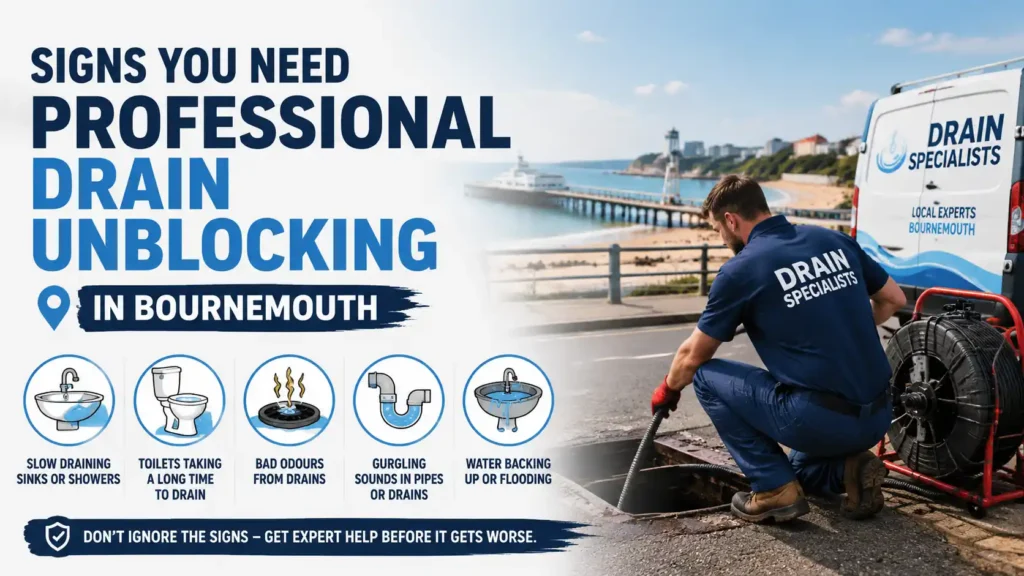
1. Slow Draining Water in Sinks, Baths or Showers
The most common early sign that something is wrong inside your drainage system is water that drains away more slowly than usual. You might notice it first in the kitchen sink, where water sits in the basin for longer than it should after washing up. It may then become apparent in the shower tray or bath, where pooling occurs even briefly during use.
This symptom is caused by a build-up of material restricting flow inside the pipe. In kitchen drains, grease and fat are the most frequent culprits. Grease poured down the sink does not wash away cleanly. It cools as it moves through the pipework and adheres to the internal walls, gradually narrowing the channel until water can no longer pass freely. In bathroom drains, the combination of hair, soap scum and personal care products creates a dense mass that accumulates over the months.
2. Persistent Unpleasant Smells from Drains
Foul odours rising from plug holes or outside gullies are one of the clearest signs that organic material is decomposing inside your drainage system. Waste that becomes trapped in a partial blockage does not remain static. It breaks down, releasing gases that travel back up through the pipes and into the property.
In kitchens, this smell is often described as a rotten or eggy odour, particularly noticeable near the sink or dishwasher outlet. In bathrooms, it tends to be more musty and persistent. Outdoors, an unpleasant smell near a gully cover or manhole often points to a blockage in the surface water or foul water drain serving that area of the property.
Air fresheners and cleaning products applied to plug holes may mask the smell temporarily but do nothing to address the source. If the odour returns within days of cleaning, the blockage is already well established and needs professional attention. Properties in Bournemouth with older clay or pitch fibre pipework can also develop smells as a result of pipe misalignment, where waste accumulates at a joint rather than in the pipe itself. A CCTV drain survey is the most reliable way to confirm the cause in these cases.
3. Gurgling Sounds from Pipes and Fixtures
A healthy drainage system is silent. Water enters the drain and passes through the pipework without any audible feedback. When you begin hearing gurgling, bubbling or clicking sounds coming from plug holes, toilet pans or waste pipes, it means air is being forced back through the system rather than passing freely.
This happens because a partial blockage is restricting flow. Water cannot move through the pipe at its normal rate, so air becomes trapped between the water and the obstruction. As water pressure builds and then releases, the trapped air is pushed back through the nearest available opening, producing the gurgling sound you hear.
In Bournemouth properties, this sign is particularly common in households where multiple appliances share a single soil stack or waste pipe. When the washing machine drains and the kitchen sink gurgles, or when flushing the upstairs toilet causes the downstairs basin to bubble, it often indicates a blockage affecting a shared section of drainage rather than just one fixture. This type of problem requires a professional inspection to identify the exact location and cause.
4. Water Backing Up or Overflowing
Water that rises in a sink, toilet or shower tray when you use a different fixture elsewhere in the property is a strong indicator that a blockage has developed in a shared section of your drainage. This is sometimes called cross-contamination, and it means that wastewater has nowhere to go when it encounters the obstruction, so it finds the nearest available outlet.
If your toilet water rises when you run the kitchen tap, or water appears in the shower tray when the washing machine empties, the blockage is likely in the main drain rather than in any individual branch. This type of problem will not resolve itself. The blockage will continue to worsen with every use of the drainage system until a complete failure occurs, at which point wastewater may back up into the property.
Outdoor overflows are equally serious. If you notice water pooling around an external gully cover, or a manhole beginning to overflow after heavy rain, the surface water or combined drain serving your property is already under significant strain. In Bournemouth, periods of heavy rainfall can expose existing partial blockages that were previously managing under normal flow conditions. Any outdoor overflow should be treated as an urgent issue requiring same-day professional attention. Drainage Care Solutions provides emergency drain repairs across Bournemouth for exactly these situations.
5. Recurring Blockages That Keep Returning
A drain that blocks, gets cleared, and then blocks again within a few weeks is not experiencing bad luck. Recurring blockages are almost always a sign of an underlying problem that a standard unblocking treatment does not address. The three most common causes are root ingress, pipe deformation and misalignment.
Root ingress occurs when tree or shrub roots detect moisture in or around a drain pipe and grow toward it. Once they find a joint or crack, they enter the pipe and gradually fill the internal space. High-pressure jetting can clear the roots, but if the entry point is not repaired, the roots will return within months. Pipe deformation, common in pitch fibre drainage throughout central and north Bournemouth, creates a narrowed section that catches waste on every pass. No amount of jetting will restore the correct bore of a deformed pitch fibre pipe. Relining or replacement is the only lasting solution.
6. Flooding in the Garden or Standing Water Near Soakaways
Standing water that appears in the garden after rain and does not drain away within a reasonable period points to a problem with either the surface water drainage or the soakaway serving the property. This is particularly common in Bournemouth and the surrounding BH postcodes, where sandy soil conditions can cause soakaways to degrade over time.
A soakaway that is silted up, collapsed or full beyond its capacity will cause surface water to back up and pool in the lowest part of the garden. In more serious cases, this water can track toward the property and cause damp in ground floor rooms or cellars. If your garden floods regularly in winter and dries out in summer, the soakaway is almost certainly the cause. Drainage Care Solutions carries out soakaway repair and replacement across Bournemouth, including the infiltration testing required before a new installation.
7. Multiple Fixtures Draining Slowly Simultaneously
When a single sink or shower drains slowly, the problem is most likely localised to that branch drain or the trap beneath the fixture. When multiple fixtures in different rooms all begin draining slowly at the same time, the blockage is much further into the system, typically in the main drain that all of those fixtures share.
This distinction matters because the type of intervention required is different. A localised blockage in a bathroom waste pipe can sometimes be addressed with mechanical rodding. A blockage in the main drain requires high-pressure jetting equipment that reaches deeper into the system and operates at much higher pressure to clear the kind of accumulated material that builds up in a main drain over time.
When to Act and Who to Call
The guidance from drainage professionals is consistent: act on the first sign rather than waiting for a full blockage or overflow. A partial blockage identified early requires a straightforward jetting treatment. The same blockage left untreated for weeks or months can cause pipe damage, root ingress to deepen, or deformed sections of pitch fibre to compress further until the pipe loses its structural integrity entirely.
Drainage Care Solutions is based in Bournemouth and covers every BH postcode district. Every engineer carries high-pressure jetting equipment and a CCTV survey camera, and attends with the aim of diagnosing and resolving the problem in a single visit. There are no call centres and no national contractors subcontracting locally. When you call, you reach a Bournemouth based team that understands the specific drainage systems, soil conditions and property types found across areas including Boscombe, Southbourne, Winton, Charminster, Kinson and Moordown.
If you have noticed any of the signs described in this guide, do not wait for the situation to escalate. Contact Drainage Care Solutions on 07717 561588 or submit an enquiry online to arrange an assessment at the earliest available time.
Frequently Asked Questions
How quickly does a partial blockage become a full blockage?
There is no fixed timeline, but blockages caused by grease, fat and soap typically worsen over a period of weeks to months. Blockages caused by root ingress or structural pipe damage can deteriorate much faster, particularly during periods of heavy rainfall or increased property use.
Can I use chemical drain cleaners instead of calling a professional?
Chemical drain cleaners may soften surface grease in minor blockages but are not effective against root ingress, pipe deformation or deep material accumulation.
What is a CCTV drain survey and do I need one?
A CCTV drain survey involves passing a specialist camera through your drain to produce a clear internal view of the pipe condition. It is recommended when a blockage recurs, when slow drainage has no obvious explanation, or when you are buying or selling a property.
Who is responsible for maintaining the drains at my property?
Drains that sit entirely within your property boundary and serve only your property are your responsibility as the homeowner. Shared drains serving more than one property are typically the responsibility of the water company, in this area usually Wessex Water or Bournemouth Water.