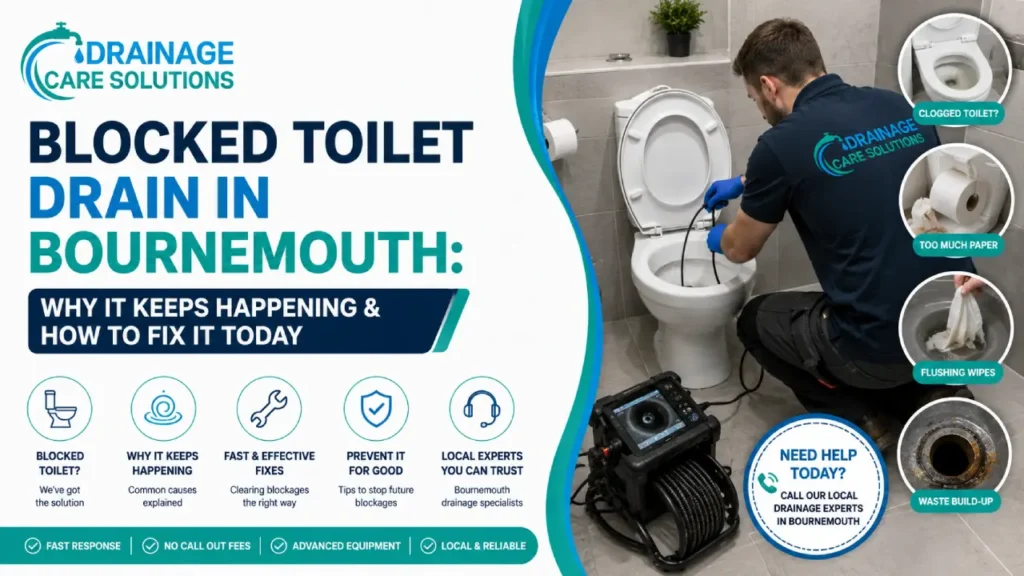
A blocked toilet drain in Bournemouth has a way of announcing itself at the worst possible moment. Water rises in the bowl, the flush slows to a crawl, and a faint sewage smell drifts in from the garden gully. If you’ve already plunged twice and the problem keeps coming back, the blockage almost certainly isn’t in the bowl it’s further down the drain. This guide walks you through how to tell the difference, what to try yourself, when to stop and call a Bournemouth drainage engineer, what it costs, and who’s actually responsible for fixing it. If you need help right now, our emergency drain repairs team covers every BH postcode the same day.
Signs Your Toilet Drain Is Blocked (Not Just the Bowl)
A blocked toilet drain shows up as slow flushing, water rising in the bowl, gurgling from nearby sinks or showers, foul smells around outside gullies, or sewage backing up into shower trays. If two or more appliances are affected at once, the blockage sits in the drain itself — not the toilet.
Watch for these warning signs together:
- Water rises slowly to the rim before draining away
- Gurgling toilet pipes after a flush, or bubbling in the bowl when you run the sink
- Bath, shower or basin draining slowly at the same time as the toilet
- A sewage smell from the outside gully or manhole
- The toilet flushes slowly but isn’t fully blocked
- Sewage backing up into the bath, shower tray or kitchen sink
The reason multiple appliances react together is your soil stack — the vertical pipe behind the bathroom wall that carries waste from every appliance into the main drain. Once that pipe or the drain below it partially blocks, every appliance feels the pressure change. A gurgling noise from anywhere in the house tells you the problem isn’t local to one fitting.
Bowl Blockage vs Drain Blockage: How to Tell the Difference
Before you waste an hour with a plunger, work out where the blockage actually sits. This quick check saves time and protects the pipework.
| Symptom | Bowl or Trap Blockage | Drain Blockage |
|---|---|---|
| Only the toilet affected | Yes | No |
| Other appliances slow or gurgling | No | Yes |
| Plunger usually works | Yes | No |
| Smell from outside gully | No | Yes |
| Returns within a few days | Sometimes | Yes |
| Inspection chamber holds standing water | No | Yes |
If the table points to a drain blockage, skip the plunger section. A plunger only generates pressure across a metre or two of pipe. A blockage in the lateral drain or shared sewer is well beyond its reach and needs proper equipment.
Why Bournemouth Toilet Drains Keep Blocking: 7 Local Causes
Bournemouth’s housing stock causes more recurring blocked toilet drains than newer towns nearby. The mix of Victorian terraces, post-war pitch fibre pipework, mature trees and hard water creates a perfect environment for repeat problems. Here are the seven causes our engineers see most across BH1 to BH11.
1. Wet Wipes Labelled Flushable
Almost no supermarket wipes meet the Water UK Fine to Flush standard. They don’t break down in cold drain water the way toilet paper does. They collect at bends, at the soil stack base, and at joints in older clay pipework. One household flushing wipes for six months is enough to fully block a 100mm soil pipe.
2. Pitch Fibre Drain Collapse
Bournemouth homes built between roughly 1950 and 1975 in Moordown, Wallisdown, Kinson and parts of Bear Cross often have pitch fibre soil pipes. The material softens and deforms inward over decades, narrowing the bore until the pipe collapses or blisters internally. Repeated blockages in this age of property nearly always trace back to pitch fibre.
3. Victorian Clay Pipework
Boscombe, parts of central Bournemouth and the older streets of Westbourne sit on original Victorian clay drainage. The joints shift over time, roots find the gaps, and the pipe wall becomes rough enough for paper and grease to catch on.
4. Tree Root Ingress
Mature gardens across BH4, BH5 and BH6 carry the highest root-ingress workload for our team. Roots enter through tiny cracks at clay joints, then expand inside the pipe until they form a mat that catches everything passing through.
5. Sanitary Products, Nappies and Cotton Buds
The 3 Ps rule pee, poo, paper exists for a reason. Anything outside that list doesn’t belong in a toilet, no matter what the packaging claims. Sanitary towels, tampons, cotton buds and nappies are the second-biggest cause of blocked toilet drains we attend in Bournemouth.
6. Limescale Build-Up in the Soil Stack
Bournemouth water is hard. Over fifteen to twenty years, limescale narrows the internal diameter of the soil pipe, especially around the rim and bends. The pipe still flushes, but the margin for catching paper or wipes shrinks every year.
7. A Shared Drain Blockage Further Downstream
If you live in a terrace or a converted flat, your toilet drain joins a shared run before reaching the sewer. The blockage may sit on a neighbour’s section of the drain or in the shared lateral. Wessex Water handles most shared sections beyond the property boundary.
For a closer look at why blockages keep returning even after clearing, read are repeated drain blockages a sign of a bigger problem.
How to Unblock a Toilet Drain Yourself: Step by Step
To unblock a toilet drain at home, stop flushing first, bail out excess water, work a flange plunger with firm vertical strokes for sixty seconds, follow with hot water and washing-up liquid, then try a toilet auger if the bowl still won’t clear. Avoid caustic drain chemicals — they damage seals and older pipework.
Method 1: The Flange Plunger Technique
A flange plunger has an extra rubber lip that folds out to seal the toilet outlet. A standard cup plunger meant for sinks won’t work — it can’t form a seal on a curved porcelain bowl.
Place the flange into the outlet, press down gently to expel air, then pump straight up and down twenty to thirty times. Keep the seal. Lift sharply on the final stroke. Repeat once if the water level drops but the blockage hasn’t fully cleared.
Method 2: Hot Water and Washing-Up Liquid
Squeeze around 200ml of washing-up liquid into the bowl. Wait five minutes for it to coat the trap. Pour in hot water from the tap — not boiling. Boiling water can crack porcelain and soften the wax seal under the toilet base. Wait fifteen minutes before testing the flush.
Method 3: Toilet Auger (Closet Auger)
A closet auger is built for toilets, with a rubber-coated curve that protects the porcelain. Feed the cable into the outlet, crank the handle clockwise as it advances, and stop the moment you feel resistance. Pull back gently. If the cable returns with wipes or roots, the auger has reached the blockage.
Method 4: Enzyme Drain Treatment for Slow Drains
Enzyme treatments work overnight on partial blockages — paper build-up, grease, soap residue. They’re safe on septic systems, mains drainage and older pipework. They won’t clear a full blockage, so use them as prevention rather than rescue.
What Not to Do
A few habits make a blocked toilet drain much worse:
- Don’t keep flushing in the hope it’ll clear — you’ll flood the floor
- Don’t use caustic soda or sulphuric acid drain unblockers damage seals and older pitch fibre
- Don’t pour boiling water into a porcelain bowl
- Don’t ignore gurgling from the bath or sink — that’s the blockage warning you it’s downstream
If two of these methods haven’t shifted the water level after thirty minutes, the blockage isn’t in the bowl. Move on to checking outside.
How to Clear a Blocked Toilet Drain Pipe Outside the House
To clear a blocked toilet drain pipe outside, find your inspection chamber, lift the cover, and check the water level. A full chamber means the blockage sits downstream. An empty one means the blockage sits between the toilet and the chamber. Drain rods can clear soft blockages but rodding a collapsed pitch fibre pipe makes the damage worse.
Most Bournemouth properties have at least one inspection chamber in the front or rear garden, often near the back door or the boundary. The cover is square or rectangular, usually cast iron or recessed concrete. Lift it carefully with a screwdriver under the lip.
If the chamber is full to the rim with sewage, the blockage is between your chamber and the public sewer. If it’s empty and the toilet still won’t flush, the blockage is between the toilet and the chamber. If you can see water flowing through the chamber but the toilet still backs up, the problem is inside the property likely the soil stack itself.
Drain rods are useful for short, straight runs in clay or modern plastic pipework. They are not safe for unknown pitch fibre. Rodding a softened pitch fibre pipe pushes the deformed wall further inward and can collapse it completely. If you don’t know what your drainage material is, book a CCTV drain survey before rodding anything.
When to Stop and Call a Bournemouth Drainage Engineer
A blocked toilet drain becomes an emergency when sewage backs up into other appliances, when there’s only one toilet in the property, when the outside manhole is overflowing, or when the same blockage returns within days. These signs point to a structural fault not a soft blockage and need same-day attention.
Stop and call a drainage engineer if:
- A plunger and auger haven’t worked after thirty minutes of effort
- Sewage is backing up into the bath, shower tray or sink
- The outside manhole is full or overflowing onto the garden
- The same toilet has blocked twice in the past month
- The property has only one toilet and it can’t be used
- The smell persists after the visible blockage clears
- You’re a landlord with a tenant unable to use the bathroom
Blocked toilet drain right now? Drainage Care Solutions covers BH1 to BH11 with same-day attendance. Call 07717 561588 or request a free quote.
How Much Does It Cost to Unblock a Toilet Drain in Bournemouth?
Unblocking a toilet drain in Bournemouth costs between £80 and £180 for a standard soft blockage cleared with high-pressure water jetting. CCTV drain surveys add £100 to £200. Collapsed pitch fibre or root ingress repairs range from £400 to £2,500 or more, depending on access, method and pipe depth. Ask for a fixed-price quote before any work starts.
| Service | Typical Bournemouth Cost (2026) | Time on Site |
|---|---|---|
| Standard toilet drain unblocking (jetting) | £80 – £180 | 30 – 60 minutes |
| Out-of-hours or emergency call-out | £150 – £280 | 30 – 60 minutes |
| CCTV drain survey with written report | £100 – £200 | 45 – 90 minutes |
| Patch repair (no-dig) | £400 – £900 | 1 day |
| Drain lining (no-dig) | £900 – £2,500 | 1 – 2 days |
| Excavated pitch fibre replacement | £1,800 – £4,500+ | 2 – 4 days |
Prices vary by access, drain depth, and whether the blockage sits on a private lateral drain or a shared sewer run. Always confirm pricing in writing before work begins. At Drainage Care Solutions, the quote you agree is the figure on the invoice.
Who’s Responsible for a Blocked Toilet Drain? Landlord, Tenant or Wessex Water
In the UK, the property owner is responsible for blocked drains within their boundary that serve only their property. Shared drains and public sewers beyond the boundary fall under Wessex Water across Bournemouth. Landlords must keep drainage in working order under Section 11 of the Landlord and Tenant Act 1985.
If You’re a Homeowner
You’re responsible for the lateral drain — the section running from your toilet to where it joins the public sewer or a shared run. Most home insurance policies cover accidental damage and trace and access costs but exclude blockages caused by normal use.
If You’re a Tenant
Report the blocked toilet drain to your landlord in writing the same day. Photograph the symptoms — water level, gurgling appliances, any smell. The landlord has a duty to act within a reasonable time under Section 11. You only become liable if the blockage was caused by clear misuse, such as flushing wipes after being told not to.
If You’re a Landlord
A single-toilet rental property needs same-day action — usually within twenty-four hours. Acting promptly protects you against disrepair claims under the Homes (Fitness for Human Habitation) Act 2018. Many Bournemouth landlords use Drainage Care Solutions specifically because we attend the same day and email the engineer’s report directly to letting agents.
When Wessex Water Takes Over
Wessex Water handles public sewers and most shared lateral drains beyond the property boundary across Bournemouth. The 2011 sewer transfer moved responsibility for most shared lateral drains from homeowners to the water company. Wessex Water operates a 24/7 line for sewer flooding and public drain issues.
How to Prevent Your Toilet Drain Blocking Again
Once a drain has blocked once, it’s more likely to block again. The pipe wall has been disturbed, paper catches more easily, and the underlying cause hasn’t gone away. A few simple habits stop most repeat blockages.
- Follow the 3 Ps rule: pee, poo, paper. Nothing else
- Bin every wipe, even those labelled flushable — unless they carry the Water UK Fine to Flush logo
- Run a monthly enzyme treatment in older Bournemouth properties with Victorian clay or pitch fibre drainage
- Book a CCTV drain survey if you’ve had two blocked toilet drains in the past twelve months
- For HMOs, holiday lets and rentals across Bournemouth, fix a printed “do not flush” notice above every toilet
- Descale the cistern and check for limescale at the bowl rim every six months in hard-water areas
If your drain keeps blocking even with sensible use, read our guide to the most common causes of repeat drain blockages in Bournemouth homes.
Why Choose Drainage Care Solutions for a Blocked Toilet Drain in Bournemouth
Drainage Care Solutions handles blocked toilet drains across Bournemouth every day. Our engineers know the local housing stock — they’ve worked on the Victorian clay in Boscombe, the pitch fibre in Moordown and Wallisdown, the converted flats around East Cliff, and the new-builds in Northbourne.
Same-day attendance across BH1 to BH11: Boscombe, Westbourne, Southbourne, Winton, Charminster, Kinson, Moordown, Talbot Woods, Wallisdown, Northbourne and East Cliff.
Pitch fibre and Victorian clay experience: the right equipment for Bournemouth’s mixed-age drainage systems, not a generic UK approach.
Fixed-price quote before any work: what we agree on the phone is what appears on the invoice. No surprise charges.
Fully insured, qualified engineers: public liability on every job. ID and insurance shown on request at the door.
Blocked toilet drain right now? Call 07717 561588 or book a same-day visit. Drainage Care Solutions covers every BH postcode in Bournemouth and the wider Dorset area.
Frequently Asked Questions
Can a blocked toilet drain unblock itself?
No. Soft blockages made only of toilet paper may partially clear with water flow over a few hours, but anything involving wipes, sanitary products, roots or limescale will not resolve on its own. If symptoms last beyond twenty-four hours, treat it as a confirmed blockage and act.
Does baking soda and vinegar unblock a toilet drain?
For minor slow drains, baking soda and vinegar can loosen light paper or soap residue. For a fully blocked toilet drain involving wipes, roots or collapsed pipework, the reaction is too weak to clear the obstruction and only delays calling a drainage engineer.
What is the best chemical to unblock a toilet drain?
Drainage engineers across the UK avoid caustic chemical unblockers. They damage rubber seals, weaken older clay and pitch fibre pipework, and rarely shift structural blockages. High-pressure water jetting is the standard professional method and is safe for every pipe material common in Bournemouth homes.
How long does it take to unblock a toilet drain?
A standard soft blockage takes thirty to sixty minutes to clear with professional water jetting. Root ingress, limescale or partial pipe collapse takes longer and usually needs a CCTV drain survey to plan the right repair. The engineer should give you a clear timeline before starting any work.
Is Wessex Water responsible for blocked drains in Bournemouth?
Wessex Water is responsible for public sewers and most shared lateral drains beyond the property boundary across Bournemouth and the wider BH postcode area. Blocked drains and toilet pipework inside the boundary remain the homeowner’s or landlord’s responsibility under UK water industry rules.
Does home insurance cover a blocked toilet drain?
Many UK home insurance policies cover accidental damage to drains and trace-and-access costs but exclude blockages caused by everyday use — wipes, grease, paper or roots. Check the policy wording before assuming cover applies. A written engineer’s report supports any claim you submit.
Why does my toilet gurgle when I flush it?
A gurgling toilet usually means air is being pulled through the trap because the soil stack or drain below is partially blocked. The blockage restricts water flow, and air finds the easiest route back through your toilet. Gurgling is an early warning — act before the drain fully blocks.