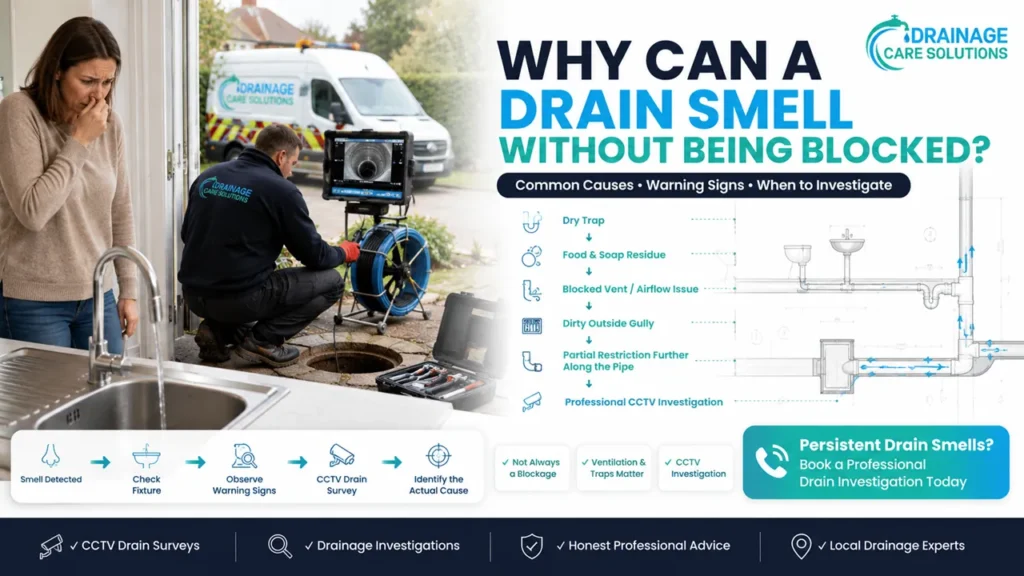
A drain can produce an unpleasant odour even while water continues to flow normally. The cause may be a dry water trap, residue near the outlet, a dirty outside gully, a damaged seal, poor drainage ventilation or retained wastewater further along the pipe.
The phrase drain smells but not blocked describes a symptom rather than a diagnosis. The location, timing and pattern of the smell usually provide more useful clues than the type of odour alone. Persistent smells may still require investigation, particularly when several fixtures are affected or other drainage symptoms begin to appear.
Drain Smells but Not Blocked: What Does the Pattern Mean?
A drain does not have to be completely obstructed before it smells. Water may still pass through a partially restricted pipe, while trapped material decomposes around the remaining opening.
The source may not be a blockage at all. A water trap can lose its seal, an internal connection can release foul air, or a ventilation problem can affect how air moves through connected pipework.
Normal-looking flow from one sink therefore does not prove that the entire drainage route is clear, correctly ventilated or free from damage.
Where Is the Smell Most Noticeable?
Odour patterns can help identify which part of the system deserves attention. They cannot confirm the cause without further checks.
| Odour Pattern | Possible Area to Check | Supporting Signs | Appropriate Next Step |
| One sink or shower smells | Trap, overflow or local waste pipe | Residue near the outlet | Inspect the affected fixture first |
| An unused fixture smells | Dry water trap | Smell improves after water runs | Refill the trap and monitor |
| Several drains smell | Shared branch, soil stack or main drain | Fixtures react together | Check the wider drainage pattern |
| Outside gully smells | Deposits or downstream restriction | Slow clearing or raised water | Observe the gully safely |
| Smell appears when water runs | Deposits or displaced air | Odour follows one appliance | Note what triggered it |
| Smell follows toilet flushing | Shared pipework or trap disturbance | Nearby fixture gurgles | Compare connected fixtures |
| Smell worsens after rain | Loaded gully or existing restriction | Outside water levels rise | Record the weather connection |
| Smell returns after cleaning | Source may be further downstream | Repeated odour or changing flow | Consider professional investigation |
The most useful question is not only “What does it smell like?” It is “What happened immediately before the smell appeared?”
Start With the Affected Fixture
When one sink, shower or bath smells but every other outlet behaves normally, the cause is more likely to be close to that fixture.
A Dry Water Trap
A water trap is the curved section of pipe beneath a sanitary appliance. It retains water to form a barrier between the room and foul air within the drainage system.
The seal may evaporate from a guest bathroom, unused shower, utility sink or vacant property. Running clean water can restore it temporarily.
If the smell disappears and remains absent while the fixture is used regularly, evaporation was a reasonable explanation. A smell that quickly returns may indicate a leaking trap, disturbed seal or another pipework issue.
Approved Document H describes water traps as part of preventing foul air from entering buildings through sanitary pipework.
Residue Near the Plughole
Food particles, grease, soap, hair, toothpaste and body oils can remain around the outlet, overflow or trap.
These deposits can support bacterial activity and create stale, musty or sewage-like smells while leaving enough space for water to pass. This explains why a dirty drain can smell before it becomes noticeably slow.
Visible debris can be removed from an accessible strainer. Avoid mixing bleach with drain cleaners or combining different chemical products.
An Outside Gully Can Flow and Still Smell
Outside gullies collect discharge from sinks, appliances and other waste pipes. Leaves, silt, grease and food residue can remain around the sides or within the trapped section while water continues through the centre.
A smell may become stronger during warm weather or when wastewater disturbs those deposits. The gully may therefore need cleaning even when it is not overflowing.
· Dirty but flowing: Water clears at its usual rate, but residue remains around the gully.
· Partially restricted: Water clears slowly, remains high or produces odour when appliances discharge.
· Possible downstream problem: The gully fills, wastewater returns or an inspection chamber remains unusually full.
Water Safe notes that foul smells can intensify when running water agitates trapped waste inside drainage pipework.
One Smelly Drain and Several Smelly Drains Suggest Different Areas
An odour limited to one basin or shower often points towards its trap, overflow, seal or local branch pipe.
When several connected fixtures smell together, the possible source moves further along the system. The shared branch, soil stack, ventilation arrangement or main private drain may need attention.
The timing can be particularly revealing. A basin that smells when a toilet flush suggests the fixtures interact through connected pipework. An odour appearing when a washing machine empty may relate to the branch receiving that sudden discharge.
Where smells occur with noise from connected outlets, the guide to what different gurgling patterns may indicate explains how the triggering fixture can help narrow the affected route.
Could Drainage Ventilation Be Responsible?
Drainage systems need controlled air movement. A soil vent pipe releases foul air and helps balance pressure as wastewater moves through the system. Some installations also use an air admittance valve, commonly called an AAV, to admit air under particular conditions.
A ventilation fault can contribute to odours if pressure changes disturb a trap seal or redirect foul air through a fixture. This may be more likely where several outlets react together.
Not every ventilation problem can be confirmed through an underground camera survey. A plumber may need to assess accessible internal fittings, valves or above-ground soil pipework.
Do not climb onto a roof to inspect a vent terminal or dismantle a concealed valve without the appropriate competence.
Damaged Seals Can Release Odours Without an Obvious Leak
A loose waste connection, perished seal or poorly fitted toilet connector may release foul air without allowing enough water to create a visible puddle.
A small crack in accessible waste pipework can cause a similar localised odour. The smell may remain concentrated inside a cupboard, around the toilet base or near a boxed-in pipe.
Above-ground traps, connectors and sanitary fittings generally fall within a plumber’s work. Underground joints, gullies, inspection chambers and external drain runs are more likely to require a drainage engineer.
This distinction helps prevent unnecessary underground work when the problem sits directly behind one fixture.
A Partial Restriction Can Smell Before the Drain Fully Blocks
A narrowing within the pipe may still allow daily wastewater to pass. Grease, silt, roots or another obstruction can trap organic material around the restricted section, where it begins to decompose.
This is a common reason a drain smells but not blocked complaint later develops into slower flow, gurgling or rising water. Running a tap may make the smell stronger because the discharge disturbs the retained material.
Where the odour appears with changing flow, checking for a partial drainage restriction is more appropriate than repeatedly masking the smell at the plughole.
A smell alone does not confirm a blockage. The additional flow symptoms make that possibility more relevant.
Standing Wastewater May Be Present Further Along the Pipe
A drain can appear to empty because each new discharge pushes some water forwards. However, part of the wastewater may remain inside a low, sagging or poorly graded section.
Solids can settle in this retained water and contribute to a persistent odour. The smell may recur even after local traps and plugholes have been cleaned.
A camera inspection may show standing water, but the image alone may not explain why it is present. Cleaning, access from another direction or further assessment can be needed to distinguish a pipe-gradient issue from a downstream restriction.
Can a Cracked Underground Drain Cause a Smell?
Yes, a crack, displaced joint or damaged connection can allow foul air or wastewater to escape. The smell may be strongest near an outside chamber, one section of garden or a particular wall.
Structural damage becomes more plausible when the odour appears alongside damp ground, recurring blockages, root ingress or changes in nearby soil.
Those signs still do not prove that the drain has cracked. Persistent external odours can also come from a dirty gully, shared drainage or retained wastewater.
The source should be confirmed before structural repair is recommended.
Why Can Rain or Warm Weather Change the Smell?
Warm weather can increase evaporation from rarely used traps and make decomposing residue around outside gullies more noticeable.
Rain can place extra demand on gullies and drainage runs that already contain deposits or partial restrictions. A smell that repeatedly appears after rainfall becomes more significant where the outside water level also rises or several fixtures begin reacting together.
The full relationship between rainfall, gullies and underground systems is covered in the guide to drainage symptoms after heavy rain.
Weather may expose an existing problem rather than create the original defect.
Is the Odour Coming from the Drain or the Water?
Before assuming the drain is responsible, notice whether the smell appears as water leaves through the plughole or comes directly from the tap.
An odour strongest around the outlet after discharge points more towards the trap or drainage connection. If the water itself smells unusual before reaching the plughole, compare another tap and note whether the issue affects hot water, cold water or both.
Where the supplied water appears to be the source, contact the relevant water supplier rather than treating the drain.
What Can You Check Before Arranging an Inspection?
When a drain smells but not blocked, begin by identifying the exact fixture or outside area involved. A local smell from one outlet requires a different starting point from an odour affecting several rooms.
Check Whether the Fixture Is Regularly Used
Run clean water into a sink, shower or floor drain that has been unused. This can restore an evaporated trap seal.
Monitor what happens afterwards. A smell that returns quickly suggests the issue may involve more than simple evaporation.
Note What Triggers the Odour
Record whether it appears after flushing, appliance discharge, heavy rain or running hot water. Notice whether another fixture gurgles at the same time.
This timing can show which outlets share part of the drainage route.
Observe Flow and Accessible Outside Areas
Check whether water drains at its normal rate. Look at an accessible outside gully from ground level and note whether it clears freely or retains an unusually high water level.
Do not enter an inspection chamber, place your face close to an open drain, climb onto a roof or dismantle concealed pipework.
When Does a Persistent Smell Need Investigation?
A drain smells but not blocked problem deserves closer attention when the odour repeatedly returns after a trap has been refilled or visible deposits have been removed.
More Than One Fixture Is Affected
Smells from several connected sinks, showers or toilets may indicate a shared pipe, soil stack, ventilation issue or underground drain problem.
Flow Begins to Change
Slow drainage, gurgling, rising water or a chamber that remains full makes a partial restriction more likely. Wastewater backup requires more urgent attention than odour alone.
The Smell Appears Near Pipework or Outside
Dampness around a connection, odour near an underground drain run or a problem that started after building work can justify an inspection of seals, joints and drainage routes.
Where smell and flow problems keep returning together, investigate the underlying cause of recurring drainage problems rather than repeatedly treating one outlet.
When Can CCTV Help?
A CCTV survey may help where the evidence points towards underground drainage rather than an above-ground trap or connector.
It can show deposits, standing water, roots, displaced joints, cracks, pipe deformation and partial obstructions. The pipe may need cleaning first so the camera can see the underlying surface.
CCTV does not diagnose every water-trap, AAV or soil-stack problem. Some sections may also be inaccessible, and a visible defect does not automatically prove it is the source of the odour.
A professional drain camera inspection is therefore useful when underground findings could change the diagnosis or repair decision, not automatically whenever a plughole smells.
Common Questions About Smelly Drains
Can a Drain Smell Without Being Blocked?
Yes. Dry traps, organic residue, faulty seals, ventilation issues and damaged pipework can produce smells while water continues to flow.
What Should I Do If My Drain Smells but Not Blocked?
Identify where the smell is strongest and what triggers it. Check whether the fixture has been unused, then monitor for slow drainage, gurgling or changes in outside water levels.
Why Does an Unused Sink Smell?
The water in its trap may have evaporated, allowing foul air to enter. Running clean water can restore the seal temporarily.
Can Food and Grease Make a Drain Smell?
Yes. Residue can remain inside a trap or nearby waste pipe and decompose before it restricts the flow noticeably.
Why Do Several Drains Smell at Once?
Several affected fixtures can indicate an issue in connected pipework, the soil stack, ventilation or the main drainage run.
Can a Vent Pipe Cause Drain Odours?
A ventilation problem may disturb trap seals or affect pressure within connected pipework. A plumber may need to assess the above-ground system.
Can a Cracked Drainpipe Release a Sewage Smell?
It can, but a persistent odour does not prove the pipe is cracked. Inspection is needed to identify the actual source.
Does Every Smelly Drain Need a CCTV Survey?
No. A local trap, seal or waste connection may be identified without CCTV. Camera inspection is more relevant when an underground problem is suspected.
What UK Drainage Guidance Says About Foul Air
Government Approved Document H covers foul-water drainage above and below ground. It explains that discharge points should use traps to prevent foul air from entering buildings and that drainage systems need suitable ventilation.
This supports the main distinction in this article: an unpleasant smell can come from a lost water seal or disrupted airflow even when the drainage route is not completely blocked.
Confirm the Cause When a Drain Smells but Not Blocked
Begin with the location and timing of the odour. One rarely used sink may point towards a dry trap, while several affected fixtures can suggest a wider connected-system issue. A persistent outside smell may involve a gully, retained wastewater or underground pipework.
Drainage Care Solutions investigates persistent drainage odours, partial restrictions and underground drainage problems in Bournemouth and surrounding areas. The appropriate next step may involve a plumbing check, cleaning, flow testing or CCTV inspection, depending on the pattern found.