Drainage problems rarely announce themselves politely. They build quietly underground, often for months or years, until one wet morning you’re staring at a flooded garden, a backed-up toilet, or a sinkhole near the patio. By then, the repair is bigger, messier, and far more disruptive than it ever needed to be.
This is exactly the problem a CCTV drain survey is designed to solve. By sending a high-resolution camera into your drainage system, qualified engineers can identify hidden faults long before they turn into emergencies giving you a clear picture of what’s happening below ground and, crucially, what to do about it.
For Bournemouth homeowners, landlords, and property buyers, especially those with older properties in Boscombe, Westbourne, Southbourne, Moordown, or Kinson. Early detection through CCTV inspection is one of the smartest preventative steps you can take. Here’s why.
What Is a CCTV Drain Survey?
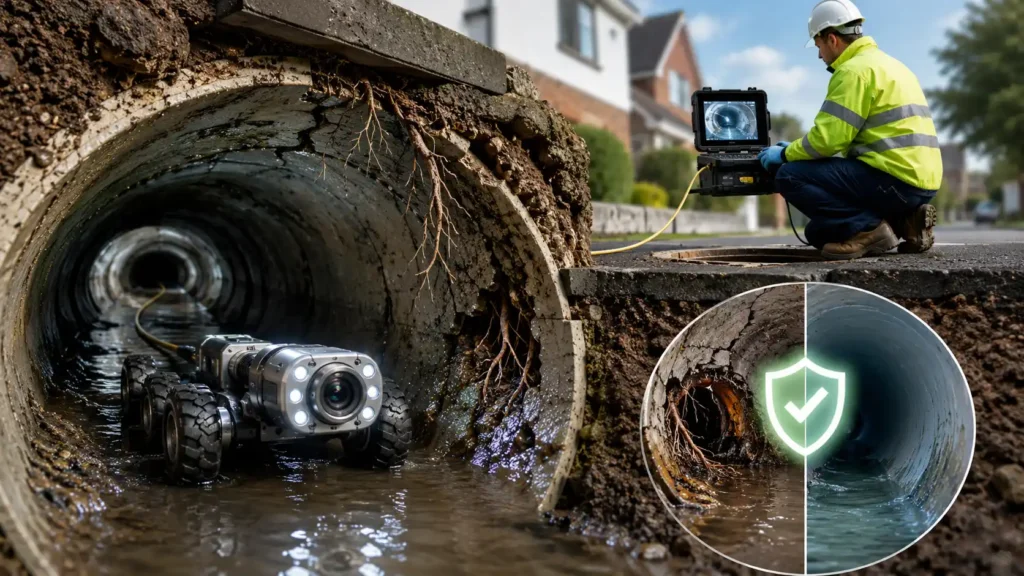
A CCTV drain survey is a non-invasive inspection where a small, waterproof, high-definition camera is fed through your drainage system via an access point. The footage is reviewed in real time and recorded, allowing the engineer to identify blockages, structural damage, root ingress, deformation, and material defects without lifting a single paving slab.
In Bournemouth, this matters more than most places. Properties built between the 1950s and 1970s often have pitch fibre drainage that can deform over decades, while Victorian terraces commonly still have original clay pipework that’s shifted with the ground. A CCTV camera tells you exactly what condition your system is in, no guesswork, no exploratory digging.
The Key Benefits of Early Detection
1. Catch Small Problems Before They Become Emergencies
The biggest advantage of an early CCTV survey is timing. A hairline crack, a partial root intrusion, or the start of a grease build-up are all simple to address when caught early. Leave them, and they grow into collapsed pipes, full blockages, and flooded properties. Early detection lets you plan repairs on your terms, not the drain’s.
2. Avoid Disruptive Excavation
Once a drain has fully collapsed or a blockage has caused structural damage, the only option is often digging up gardens, driveways, or even floors. Catching the problem early opens the door to no-dig repair methods like patch lining and pipe relining, which restore the drain from the inside without disturbing the surface above. Our emergency drain repair team uses these techniques routinely, but they’re only possible if the pipe hasn’t deteriorated too far.
3. Accurate Diagnosis, Not Guesswork
A recurring blockage that keeps coming back after every jetting isn’t a clearing problem; it’s a structural one. Without a camera, you’re treating symptoms while the underlying cause keeps producing them. A CCTV drain survey pinpoints the exact location, depth, and nature of the issue, so the right repair happens the first time. No return visits. No repeated call-outs.
4. Essential Protection for Property Buyers and Sellers
If you’re buying an older Bournemouth property, drainage is one of the few things a standard homebuyer’s survey doesn’t properly cover. A CCTV survey closes that gap. It tells you exactly what condition the drains are in before contracts are exchanged and if defects are found, it gives you solid evidence to renegotiate or request repairs as a condition of sale. For sellers, a clean drainage report removes a potential sticking point and reassures buyers their offer is sound.
5. Reliable Evidence for Insurance and Disputes
Insurers, mortgage lenders, and water companies frequently request documented evidence before approving claims or accepting responsibility for shared drainage. A written CCTV report, complete with footage references, defect locations, and engineer findings, gives you the documentation needed to support claims, settle boundary disputes with neighbours, or confirm responsibility on shared drain runs with Wessex Water. Without it, you’re relying on opinion. With it, you have a record.
6. Extends the Lifespan of Your Drainage System
Drains, like any other part of your property, age better with regular check-ups. Identifying minor defects early, a small crack, mild root ingress, slight pipe displacement, lets you address them before they compromise the whole system. For older homes with original clay or pitch fibre pipework, periodic CCTV inspection is genuinely one of the best ways to extend the working life of the entire drainage network and avoid premature full replacement.
7. Protects Property Foundations and Landscaping
Undetected leaks from cracked drains soak surrounding soil, causing erosion, subsidence, and damage to nearby foundations, patios, and driveways. In Bournemouth’s sandy soil conditions, this can also overwhelm soakaways and lead to flooded gardens. Early CCTV detection identifies leaks at the source, so the problem is fixed before it damages the structure of your home or the integrity of nearby installations like a soakaway system.
8. Peace of Mind for Landlords and Letting Agents
Under Section 11 of the Landlord and Tenant Act, landlords are legally required to keep drainage in working order. A periodic CCTV survey gives landlords and letting agents documented proof that drainage has been inspected, any issues identified, and repairs scheduled, protecting both tenant welfare and the landlord’s position should a dispute arise.
Common Drainage Issues a CCTV Survey Catches Early
A typical inspection identifies the following defects, most of which are far easier to fix in their early stages:
- Tree root ingress: Roots seeking moisture force their way through joints and small cracks, expanding and blocking flow over time.
- Hairline cracks and fractures: Caused by ground movement, ageing material, or pressure from above, allowing water to escape into surrounding soil.
- Grease, fat and silt build-up: Gradually narrows the pipe, traps further debris, and eventually causes full blocked drains.
- Pipe deformation and pitch fibre collapse: Common in Bournemouth homes built between the 1950s and 1970s, where original drainage materials are now reaching end of life.
- Displaced joints and misalignment: Caused by shifting soil, leading to leaks, blockages, and slow drainage.
- Scale and corrosion: Particularly in older cast iron and clay systems, where rough internal surfaces accelerate further debris accumulation.
- Damaged or missing covers and access points: Safety hazards that also let in debris and pests.
- Soakaway failure: Increasingly common across Dorset due to silt build-up and sandy soil conditions.
Signs You Should Book a Survey Now
You don’t need a fully blocked drain to justify a CCTV inspection. Consider booking one if you’ve noticed any of these:
- A blockage that keeps coming back after clearing
- Persistent slow drainage that has no obvious cause
- Gurgling sounds from toilets or sinks
- Bad smells from gullies, manholes, or plug holes
- Damp patches, soggy ground, or sinking paving near drain runs
- You’re buying, selling, or letting an older property in Bournemouth
- Your property is over 50 years old and has never had a drainage inspection
If any of these sound familiar, an early CCTV survey is almost always the right next step.
Book Your CCTV Drain Survey in Bournemouth
The drains under your property are out of sight, but they shouldn’t be out of mind. A CCTV drain survey takes the guesswork out of drainage care, giving you a clear, recorded picture of exactly what’s happening below ground and the time to fix any issues before they escalate.
At Drainage Care Solutions, our qualified engineers carry CCTV survey cameras on every job, and provide detailed written reports suitable for homebuyer negotiations, insurance claims, and landlord records. We cover Bournemouth, Poole, Christchurch, Ringwood, and every BH postcode district, with same-day attendance available where needed.