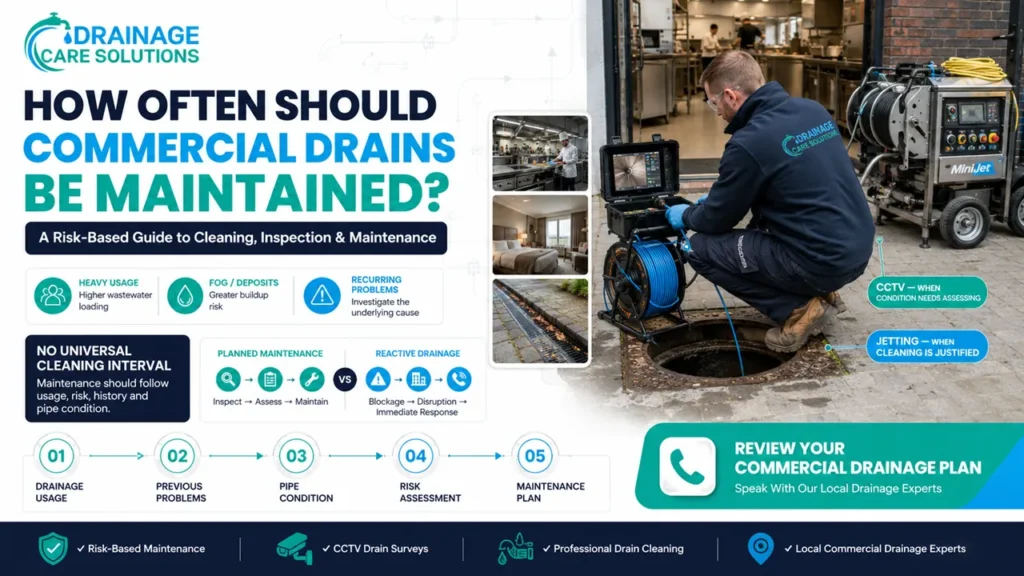
There is no single cleaning interval that suits every commercial drainage system. Commercial drain maintenance should be based on how heavily the drains are used, what enters them, previous blockage history, pipe condition and how disruptive drainage failure would be to the business.
A quiet office may require relatively little intervention compared with a busy restaurant, hotel or high-occupancy site. The useful question is therefore not simply “How often?” but “What drainage risks does this particular business need to manage?”
How Often Should Commercial Drain Maintenance Be Scheduled?
A business should set its drainage schedule according to risk and condition rather than an arbitrary monthly, quarterly or annual timetable.
Higher wastewater volumes, frequent food preparation, recurring restrictions, heavy silt exposure or known drainage defects may justify more frequent attention. A system that remains clear and has no recurring symptoms may not need the same level of intervention.
The following factors help show whether maintenance demand is relatively low or increasing.
| Maintenance Trigger | What It May Suggest | Appropriate Response |
| Low daily usage | Lower drainage loading | Continue monitoring |
| Heavy daily use | Greater volume through the system | Review inspection frequency |
| Regular FOG exposure | Greater deposit risk | Review grease management and cleaning |
| Repeat blockage | Schedule may be insufficient or another fault exists | Investigate the cause |
| Slow flow or gurgling | Possible developing restriction | Assess the affected drainage |
| External silt and debris | Gullies or channels may accumulate material | Include external drainage checks |
| Known pipe defect | Cleaning alone may not resolve the issue | Consider condition assessment or repair |
| No recurring symptoms | Existing approach may be adequate | Retain and periodically review the plan |
The table is not a mandatory frequency chart. The same type of premises can have very different drainage requirements depending on occupancy, layout, staff practices and pipe condition.
What Does Planned Commercial Drainage Maintenance Actually Mean?
Planned maintenance is work carried out before an active drainage failure develops. It may include checking accessible gullies and inspection chambers, assessing recurring problem areas, removing justified deposits and reviewing maintenance records.
It should not mean cleaning every drain simply because a scheduled date has arrived.
Planned Work Responds to Condition
A maintenance visit may find that some sections need attention while others are operating normally. High-pressure water jetting may be appropriate for certain deposits or restrictions, but it should not automatically be applied to every drain.
The condition of the pipe, the material present, access and previous problems all influence the appropriate response.
Reactive Work Starts with an Existing Problem
Reactive drainage work is different. A business may already have wastewater backing up, an overflowing gully or an active obstruction that needs flow restored.
Where a business already has an obstruction, professional commercial drain unblocking addresses that immediate problem rather than acting as routine maintenance. Drainage Care Solutions confirms that its Bournemouth drain-unblocking service covers business premises as well as homes and rental properties.
Which Commercial Sites May Need Closer Drainage Attention?
Business type matters because it affects both drainage load and what enters the system. It does not, however, create a universal maintenance interval.
Restaurants, Cafés and Commercial Kitchens
Food preparation introduces a particular risk from fats, oils and grease, usually shortened to FOG. Food particles and high wastewater volumes can add further pressure to kitchen drainage.
Water UK advises businesses to keep cooking fats out of drains, train staff in responsible disposal and use suitable equipment to capture waste before it enters drainage.
A kitchen with frequent grease accumulation may therefore require closer monitoring than an office kitchenette used by a small number of staff.
Hotels, Schools and Care Settings
Hotels can have toilets, showers, kitchens and laundry areas operating through the same premises. Schools may experience concentrated periods of toilet and kitchen use, while care facilities often have consistently high sanitary and laundry demand.
The maintenance plan should reflect these usage patterns rather than treating every drain on the site identically.
Yards, Car Parks and External Commercial Areas
Commercial drainage is not limited to foul-water pipes. Gullies, channels and silt traps serving yards, loading spaces and external areas may collect leaves, sediment and other surface debris.
A business with substantial external drainage may therefore need a different inspection strategy from premises where almost all wastewater is generated internally.
Why Do Food Businesses Need a FOG Strategy?
Fats, oils and grease can cool and solidify within drainage, where they contribute to deposits and blockages. Water UK specifically advises businesses to prevent these substances from entering drains and to collect waste appropriately.
For commercial kitchens, drainage maintenance should therefore sit alongside kitchen operating practices. Repeatedly cleaning a pipe without addressing how grease enters it may only treat the consequence.
Grease traps, separators or grease removal units also have their own maintenance requirements. Those requirements should reflect the equipment type, manufacturer guidance, actual usage and the amount of material collected rather than an invented universal service interval.
Section 111 of the Water Industry Act 1991 restricts putting matter into a sewer that may injure it, interfere with its free flow or prejudicially affect treatment or disposal. Businesses should therefore manage FOG responsibly rather than treating the sewer as a waste-disposal route.
When Does CCTV Belong in a Maintenance Programme?
Not every maintenance visit needs a camera survey.
A commercial CCTV drain inspection becomes more useful when cleaning alone does not explain what is happening. Examples include a recurring obstruction, suspected pipe damage, an unexplained restriction or a need to establish the visible condition of accessible underground drainage.
Drainage Care Solutions states that its CCTV assessment of underground pipework can identify visible blockages, cracks, displaced joints, root ingress, deformation and collapsed sections where the pipework can be accessed and inspected.
That information can then influence the maintenance plan. A drain with a structural defect may need repair or monitoring rather than simply more frequent cleaning.
Build the Maintenance Schedule from Evidence
A useful drainage maintenance programme develops over time. The first schedule is a starting point, not a permanent rule.
1. Identify the Main Drainage Loads
Map kitchens, toilets, floor drains, external gullies and other heavily used areas. Note which parts of the business create the most wastewater or deposit risk.
2. Review Previous Problems
Look at where blockages, slow flow or overflows have occurred. A repeated problem in the same drain deserves more investigation than several unrelated one-off incidents.
The existing guide to why the same drain keeps blocking explains why clearing a blockage does not necessarily remove the reason it formed.
3. Consider the Operational Consequence
A lightly used store-room floor drain does not have the same operational importance as drainage serving customer toilets or a working commercial kitchen.
More critical drainage may justify closer monitoring because disruption has a greater effect on the premises.
4. Establish Condition Where Necessary
Where the drainage history is unclear or problems repeatedly return, an inspection may provide useful baseline information about accessible pipework.
5. Set an Initial Programme
Combine usage, deposit risks, history and condition. Avoid copying another business’s maintenance timetable simply because it operates in the same industry.
6. Record What Each Visit Finds
Maintenance records should show which areas were checked, what was identified, what work was completed and which locations continue to cause concern.
7. Adjust the Interval
If deposits repeatedly return before the next planned visit, the interval or operating practices may need reviewing. If repeated visits find no material issue, the business can consider whether the current level of intervention remains proportionate.
This feedback loop is what turns routine cleaning into useful commercial drain maintenance.
Which Warning Signs Should Trigger an Earlier Review?
A maintenance plan should change when the drainage behaviour changes.
A drain becoming progressively slower deserves attention before it stops flowing completely. Recurring gurgling, gullies that remain unusually full, repeated obstructions or an increasing need for reactive clearance can also indicate that the current approach needs review.
Persistent odours deserve similar consideration, although smell does not automatically mean a blockage exists. The guide to causes of persistent drain odours explains that traps, deposits, ventilation problems, damaged seals and partial restrictions can all create odour while drainage still appears to flow.
The important distinction is that these symptoms are triggers for assessment, not proof that maintenance has been neglected.
Is Planned Maintenance Better Than Waiting for a Blockage?
For drainage with identifiable recurring risks, planned maintenance gives the business an opportunity to inspect and address conditions before an active obstruction develops.
It can also be arranged around operational requirements rather than starting unexpectedly when a drain stops working.
That does not mean preventative drainage maintenance eliminates emergencies. Roots, displaced joints, damaged pipes, foreign objects or sudden structural failure can still create problems.
Where inspection identifies damaged pipework, structural commercial drain repairs may be more appropriate than continually shortening the cleaning interval.
Does Every Commercial Drain Need Regular Jetting?
No. Jetting is a cleaning method, not a maintenance programme in itself.
Whether it is appropriate depends on the material present, pipe condition, diameter, access and the problem being addressed. Drainage Care Solutions also states on its blocked-drain service page that high-pressure water jetting may be used depending on the specific blockage and likely cause rather than automatically in every case.
An evidence-led programme therefore asks why cleaning is required before deciding how it should be carried out.
Commercial Drain Maintenance FAQs
How Often Should Commercial Drains Be Maintained?
There is no universal interval. Frequency should reflect drainage usage, business activity, previous problems, deposits, pipe condition and the consequences of a drainage failure.
How Often Should Restaurant Drains Be Cleaned?
Restaurants should not rely on one generic timetable. A busy kitchen with significant FOG exposure may need more frequent attention than premises with lower wastewater and grease loading.
What Does Commercial Drain Maintenance Include?
It can include accessible drainage checks, justified cleaning, inspection of gullies or chambers, grease-management review, record keeping and CCTV assessment where the condition or recurring symptoms justify it.
Does Every Maintenance Visit Require Jetting?
No. Jetting should be used where it is suitable for the drainage condition and deposits present. Some visits may involve inspection or monitoring rather than cleaning.
Should Commercial Drains Have Regular CCTV Surveys?
Not automatically. CCTV is most useful where problems recur, pipe damage is suspected, the cause cannot be confirmed or condition information would help determine future maintenance.
Can Commercial Drain Maintenance Prevent Every Blockage?
No. It can reduce avoidable drainage problems, but structural defects, root ingress, misuse and unexpected failures can still cause blockages.
When Should a Maintenance Schedule Be Changed?
Review it when the same problems return before planned visits, drainage behaviour changes or inspections reveal defects. It may also be appropriate to reassess a schedule that repeatedly finds no maintenance need.
Make the Schedule Fit the Business
Effective commercial drain maintenance is not about choosing a standard calendar interval and applying it to every site. The schedule should follow the business activity, drainage load, FOG or debris exposure, previous incidents and actual pipe condition.
Drainage Care Solutions supports Bournemouth businesses with drainage investigation, blockage clearance and CCTV inspection. Where recurring problems are affecting a commercial property or an existing maintenance approach needs reviewing, the useful starting point is to assess the drainage risks and establish which parts of the system genuinely need planned attention.