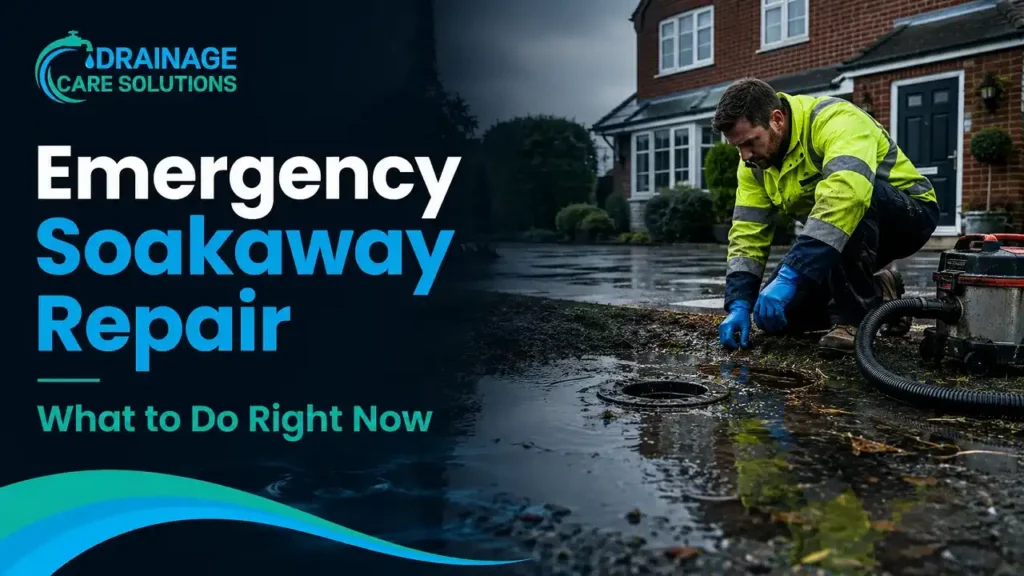
A failing soakaway is not a problem you can leave for the weekend. Once a soakaway has stopped dispersing water, every flush of a toilet, every load of laundry, and every shower adds to the volume sitting in the system with nowhere to go. Within hours, that water either backs up indoors or floods the garden. Knowing exactly what to do in the first hour of an emergency soakaway repair situation is the difference between contained damage and a full-scale clean-up.
This guide walks you through the immediate steps to take right now, then through 24 hours, 72 hours, and the longer assessment that follows. At Drainage Care Solutions we attend emergency soakaway repair calls across Bournemouth, Boscombe, Southbourne, Winton, and the wider BH postcode area with same-day response. The first hour of your response usually determines how bad the damage gets.
What Counts as an Emergency Soakaway Repair Situation?
An emergency soakaway repair situation exists when water is backing up indoors, when raw sewage is surfacing in the garden, when foul water is pooling near the property’s foundations, or when the septic tank can no longer drain into the soakaway and is approaching full capacity. These conditions cause health risks, structural damage, and contamination that escalate by the hour.
The four genuine emergency conditions:
- Indoor backup: sewage or wastewater rising through indoor drains, toilets, or sinks.
- Surface flooding: foul water pooling on top of the soakaway area.
- Septic tank near full: tank cannot empty because the soakaway is blocked.
- Foundation risk: saturated ground undermining nearby walls or driveways.
If any of these match your situation, emergency soakaway repair is genuinely urgent. The rest of this guide explains exactly what to do.
What Should You Do in the First Hour?
In the first hour of an emergency soakaway repair situation, you should stop all water use in the property, isolate the affected area, check the septic tank or sewage treatment plant level, contain any surface flooding with sandbags or barriers, and call a qualified drainage engineer. Acting fast in the first hour prevents the problem escalating from contained to catastrophic.
Immediate Action Checklist
- Stop using water indoors: no flushing, no showers, no laundry, no washing up.
- Check the septic tank or treatment plant level: if full, do not allow more flow.
- Open the inspection chamber near the soakaway and check for backup.
- Contain surface flooding: sandbags, tarpaulin, or buckets to keep water away from buildings.
- Photograph everything: for insurance and engineer records.
- Call a drainage engineer: same-day response is critical.
Stopping water use immediately is the single most important action. Every flush adds water to a system that already cannot cope, and the consequences compound quickly.
What Causes Soakaway Emergencies?
Soakaway emergencies usually result from one of four underlying problems: siltation of an old soakaway pit, tree root ingress through pipework, damage to the septic tank baffle or dip pipe allowing solids into the system, or complete soakaway failure after years of slow decline. Heavy rain or unusual water demand often triggers the visible emergency, but the underlying cause has usually been developing for months.
Common Root Causes
- Old rubble pit soakaway silted solid through years of fine sediment.
- Pitch fibre pipework deformed into a sliver-shaped collapse.
- Tree root ingress in clay or concrete pipework.
- Damaged septic tank baffle or dip pipe allowing solids into the soakaway.
- Undersized soakaway failing during peak water use.
- Saturated ground during heavy rain on heavy clay soil.
In Bournemouth’s sandy soils, soakaways tend to last longer than in clay-heavy areas, but high winter water tables can overwhelm even a working system. Homeowners with septic tanks must also comply with the Environment Agency rules on sewage discharge from septic tanks, which include the General Binding Rules introduced in recent years. Non-compliance can result in enforcement action regardless of whether the soakaway is working.
Soakaway Flooding Your Garden Right Now?
Drainage Care Solutions provides same-day soakaway replacement Bournemouth services with full BRE 365 percolation testing before any new installation. Our engineers reach Bournemouth properties fast. Call us or book a same-day drainage assessment right now.
What Happens in the First 24 Hours?
In the first 24 hours after an emergency soakaway repair situation begins, your engineer should arrive on site, complete an initial assessment, identify the immediate cause, and either implement temporary containment or begin permanent works. The first 24 hours determines whether the situation stabilises or escalates further.
Engineer Assessment
A qualified engineer carries out:
- Visual inspection of the soakaway area, garden, and indoor drains.
- CCTV survey of the connecting pipework where access allows.
- Percolation testing if soakaway replacement is being considered.
- Tank inspection of the septic tank or treatment plant level.
- Identification of the root cause.
Temporary Containment Where Needed
If the soakaway needs full replacement, temporary measures keep the situation safe in the meantime:
- Pumping the septic tank to relieve immediate pressure.
- Diverting surface water where possible.
- Containment of contamination around the affected area.
- Building Control notification if structural risk is identified.
These temporary steps buy time for proper emergency soakaway repair work to be planned and executed properly rather than rushed badly.
What Happens in the First 72 Hours?
In the first 72 hours, planning the permanent emergency soakaway repair work begins in earnest. This includes confirming whether the soakaway needs full replacement (most cases) or repair (rarely possible), arranging materials and crew, completing Building Control notifications if needed, and scheduling the works. By the end of 72 hours, your engineer should give you a clear plan with a confirmed timeline.
Decision Tree at 72 Hours
- Can the soakaway be repaired? Rarely, only when the failure is localized.
- Does it need full replacement? Most emergency cases, yes.
- Where will the new soakaway be sited? Must meet Building Regulations Part H distance rules (5 metres from buildings).
- What size crate system is needed? Based on percolation test results and property usage, following standards laid out in the SuDS Manual from CIRIA for sustainable drainage system design.
- What’s the insurance position? Buildings insurance may cover accidental damage.
Most genuine emergency soakaway repair situations end in full replacement. Old rubble pit soakaways that have silted solid cannot be saved, and pipework that has collapsed cannot be jetted back into shape. New installations use modern soakaway crates wrapped in non-woven geotextile membrane for far longer life.
Need Urgent Professional Help?
Drainage Care Solutions provides emergency drain repair Bournemouth and full soakaway replacement across the BH postcode area, with same-day attendance and qualified engineers carrying full equipment. Call or request an engineer visit today.
How Do You Prevent Soakaway Emergencies in Future?
You prevent soakaway emergencies in future by getting your septic tank emptied regularly, controlling what goes down indoor drains, watching for early signs of soakaway failure, and arranging periodic professional inspection. Prevention is far cheaper than emergency soakaway repair, especially when the alternative is a full replacement.
Prevention Checklist
- Annual septic tank emptying: removes solids before they reach the soakaway.
- No fats, oils, or wipes in toilets or sinks.
- Watch for early warning signs: spongy ground, slow drainage, faint smells.
- Annual soakaway inspection: for older systems, especially rubble pit designs.
- Tree planning: keep aggressive root systems (willow, poplar) well away from the soakaway.
Knowing the early signs prevents most emergency soakaway repair situations from happening at all.
Acting Fast on Soakaway Emergencies
A genuine soakaway emergency is one of the few drainage situations where every hour matters. The first hour of your response determines whether the damage stays contained or escalates into something far bigger. Stopping water use, isolating the problem, and calling a qualified engineer immediately are the three actions that make the biggest difference.
Drainage Care Solutions provides honest same-day assessment, BRE 365 percolation testing, and full soakaway replacement across Bournemouth, Poole, Christchurch, and the BH postcode area. Call or get a free drainage quote when you need urgent professional help.
Soakaway Emergency Questions UK Homeowners Ask Most
How Quickly Does an Emergency Soakaway Need Fixing?
A genuine emergency soakaway needs same-day attention to prevent sewage backup, ground contamination, foundation undermining, and property damage. Partial failures can sometimes wait a few days, but full failures with surface flooding or indoor backup need immediate action. Every hour of continued water use during a soakaway emergency adds to the damage.
Can A Soakaway Be Repaired or Does It Always Need Replacing?
Most failed soakaways need full replacement rather than repair, especially older rubble pit designs that have silted solid. Modern soakaway crate systems sometimes allow targeted repair if damage is localised, but the most common outcome of emergency soakaway repair work is a properly sized replacement. A percolation test confirms whether the surrounding ground can support a new soakaway.
Will Buildings Insurance Cover Emergency Soakaway Repair?
Some UK buildings insurance policies cover accidental damage to soakaways and subsidence-related failures, but exclude gradual failure, root ingress (often classed as maintenance), and general wear. A written engineer’s report with WRc condition coding is often required as evidence. Read your policy carefully and document every step of the emergency from the first hour.
What’s The Difference Between a Blocked Soakaway and A Failed Soakaway?
A blocked soakaway has an obstruction in the pipework that can sometimes be cleared. A failed soakaway has reached the end of its working life and cannot disperse water regardless of how much you clear. Most older rubble pits that fail have silted solid through years of fine sediment build-up, which is structural failure rather than blockage. The fix is replacement.
How Long Does a New Soakaway Installation Take?
A standard domestic soakaway installation in Bournemouth sandy soil conditions usually takes one full working day for the excavation, crate installation, geotextile wrapping, and backfilling. Larger systems or restricted access sites take longer. Your engineer confirms the timeline at the assessment stage so you can plan around it rather than face surprises.