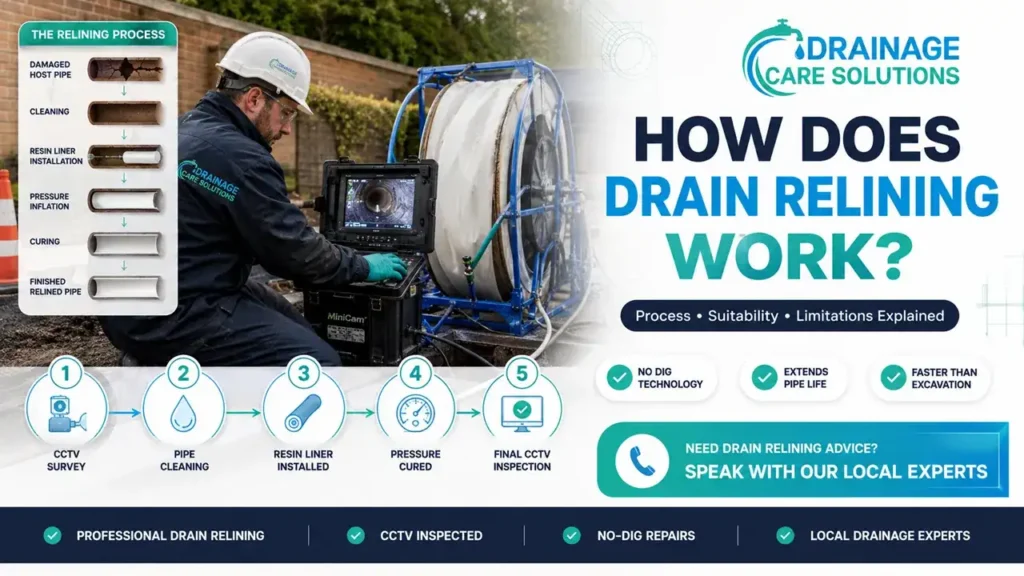
How does drain relining work? The existing drain is surveyed, cleaned and prepared before a resin-saturated liner is installed inside it. Pressure holds the liner against the old pipe wall while the resin cures, forming a close-fitting new pipe within the original drain.
Drainage Care Solutions provides drain inspection and repair services in Bournemouth and surrounding areas. Relining can avoid extensive excavation in suitable cases, but the pipe must first be checked for access, shape, damage and usable connections.
A New Pipe Is Formed Inside the Existing Drain
Drain relining does not remove the original pipe. It uses the old drain as the host pipe and creates a hardened internal lining that follows its route.
The finished liner may seal cracks, open joints and other defects, depending on its design and the condition of the host pipe. It is often described as a pipe within a pipe, although the original drain remains around the new lining.
A simple blockage is different. Grease, silt or another obstruction must be cleared, but a blockage alone does not require a structural liner.
The Survey Decides Whether Lining Can Go Ahead
A CCTV inspection normally comes first because the contractor must establish whether the liner can pass through the drain and expand correctly. A camera survey records the pipe material, diameter, route, joints, bends, roots, deformation and branch connections.
Drainage Care Solutions can carry out a camera-based drain assessment before a repair method is chosen.
The assessment usually answers four questions:
- Is There a Continuous Pipe Route?
A liner needs a usable path through the damaged section. - Can the Pipe Be Cleaned Properly?
Roots, deposits and solid obstructions may prevent installation. - Are the Defects Suitable for Lining?
Cracks and leaking joints are different from a missing pipe section. - Can the Required Access Be Achieved?
Inspection chambers, pipe ends and branch locations affect the installation plan.
A homeowner asking “how does drain relining work?” should therefore expect the answer to begin with inspection rather than liner installation.
Preparation Is More Than Cleaning
The host pipe needs to act as a mould for the new liner. Anything that changes its internal shape can affect the finished repair.
Deposits and Loose Material
High-pressure water jetting may remove silt, grease and loose deposits. The objective is to expose the pipe wall and create enough space for the liner, not simply make water flow again.
Roots and Hard Obstructions
Root growth, scale or intruding material may need specialist cutting. Any sharp edge left inside the drain could damage the liner or stop it expanding evenly.
Local Defects Before Full Lining
A badly displaced joint, heavy water infiltration or a short deformed section may need preliminary work. This could involve a local patch, sealing, pipe re-rounding or limited excavation before a longer liner is installed.
How the Liner Reaches the Damaged Section
Cured-in-place pipe, shortened to CIPP, uses a flexible tube impregnated with thermosetting resin. The tube is positioned inside the surveyed drain and expanded against the host pipe.
The UK trenchless lining guidance describes two common installation approaches:
| Installation Method | What Happens | Why It May Be Chosen |
| Pull-In-Place | The prepared liner is pulled through the drain before an internal tube expands it | Useful where suitable access is available at both ends |
| Inversion | Air or water pressure turns the liner through the pipe as it enters | Can install the liner while controlling the resin-bearing surface |
The chosen method depends on the lining system, pipe layout, access and repair design. Neither method should be presented as suitable for every drain.
Pressure and Curing Create the Finished Lining
First, Expansion:
Air or water pressure pushes the liner against the internal wall of the host pipe. The material must follow the pipe without excessive folds, movement or trapped debris.
Next, Curing:
The resin hardens while the liner remains supported. Curing may take place at ambient temperature or use hot water, steam or ultraviolet light, depending on the lining system.
Finally, Stabilisation:
The contractor allows the liner to reach the required cured condition before removing temporary installation equipment and trimming the ends.
This is the central answer to how does drain relining work inside the pipe: the flexible liner is shaped by pressure and converted into a rigid internal repair through curing.
Branch Connections Must Be Found Again
A full-length liner may temporarily cover the points where smaller drains enter the repaired run. These lateral connections must be identified and reopened if they are still required.
Before Curing
Their positions should already be recorded during the survey and installation planning. Missing a connection can leave part of the drainage system isolated.
After Curing
A CCTV-guided cutting tool may be used to reopen the branch accurately. The liner ends are also trimmed at the available access points.
The final camera inspection should confirm that the liner surface is satisfactory, the ends are finished and the necessary branches are open. Flow testing checks that wastewater passes through the repaired section.
Suitable Drains Usually Keep Their Basic Shape
Relining may be considered when the drain has structural defects but still provides a workable route. Possible examples include:
- Cracks or fractures along the pipe wall
- Open or leaking pipe joints
- Root entry through joints or small defects
- Corrosion or surface deterioration
- Several defects along one continuous drain run
- Some deformation where the pipe can still be prepared
- Water infiltration that can be controlled during the work
Suitability depends on the full pipe condition, access, diameter, bends, connections and selected lining system. Drainage Care Solutions may recommend structural drainage repairs involving a patch, full liner, excavation or replacement after inspection.
Some Conditions Leave Too Little Pipe to Line
A liner needs a continuous route and a host pipe capable of supporting installation. Complete collapse, a missing pipe section or an obstruction that cannot be removed may prevent the liner from reaching the required position.
- Severe Displacement: A joint that has moved too far may create a step the liner cannot negotiate reliably.
- Major Deformation: A badly flattened or crushed pipe may not leave a usable finished bore.
- Inaccessible Sections: Some drains cannot be reached from suitable access points without additional work.
- Extensive Failure: Widespread loss of shape or surrounding ground problems may make replacement more practical.
Not every deformation automatically rules out lining. Some pipes can be re-rounded or repaired locally first. The guide to recognising serious pipe failure explains why a complete collapse requires a different response from an ordinary blockage.
Patch Lining and Full Relining Solve Different Problems
Use the defect pattern to choose the repair length.
One Isolated Defect
A localised patch may cover a short crack, failed joint or small damaged section.
Several Defects on One Run
Full-length relining may provide a continuous repair across the affected pipe.
No Reliable Host Pipe
Targeted excavation or replacement may be needed instead.
Patch lining uses a short resin-impregnated repair positioned over a specific defect. Full relining covers a longer drain run. They use related materials and curing principles, but they should not be described as the same service.
Questions to Ask Before Approving the Work
A clear quotation should explain the surveyed problem and how the proposed liner addresses it.
- Which recorded defects will the repair cover?
- Is the proposal for a patch or a full-length liner?
- What cleaning or preparation is required?
- How will the liner be installed and cured?
- Are branch connections present?
- How will those connections be reopened?
- Could limited excavation still become necessary?
- How will the finished repair be inspected?
- What CCTV footage or completion records will be supplied?
- What alternative is recommended if the pipe proves unsuitable?
The contractor should distinguish confirmed work from possible additional work. Cleaning can expose damage that was hidden by roots, deposits or standing water.
Questions Property Owners Ask About Relining
How Does Drain Relining Work?
The pipe is inspected, cleaned and prepared before a resin-saturated liner is inserted, expanded and cured. The completed lining is then checked by CCTV and flow testing.
Is a CCTV Survey Always Needed First?
A survey is normally required to establish the pipe route, defects, access and branch connections. The contractor may also need measurements or further preparation checks.
Does Relining Reduce the Pipe Diameter?
The liner occupies some space inside the original pipe, so the internal diameter is normally reduced slightly. The finished bore depends on the liner design and host-pipe condition.
Can a Collapsed Drain Be Relined?
A partially deformed pipe may sometimes be prepared or re-rounded. A complete collapse or missing section commonly requires excavation or replacement because there is no continuous route for the liner.
How Is the Completed Repair Checked?
A post-installation CCTV survey checks the liner surface, ends and reopened branches. Flow testing and any system-specific quality checks can then be completed.
Does Drain Relining Always Avoid Excavation?
No. Access work, a local repair or targeted excavation may still be needed where the drain is inaccessible, badly displaced or completely collapsed.
The Repair Choice Should Follow the Pipe Evidence
How does drain relining work successfully? It relies on a suitable host pipe, thorough preparation, correct liner installation, controlled curing and a final inspection. Skipping any of these stages can affect the result.
Drainage Care Solutions can inspect damaged drains in Bournemouth and surrounding areas, explain whether relining may be suitable and discuss alternatives where patch repair, excavation or replacement is required. Property owners can contact Bournemouth drainage support for a condition-led assessment.