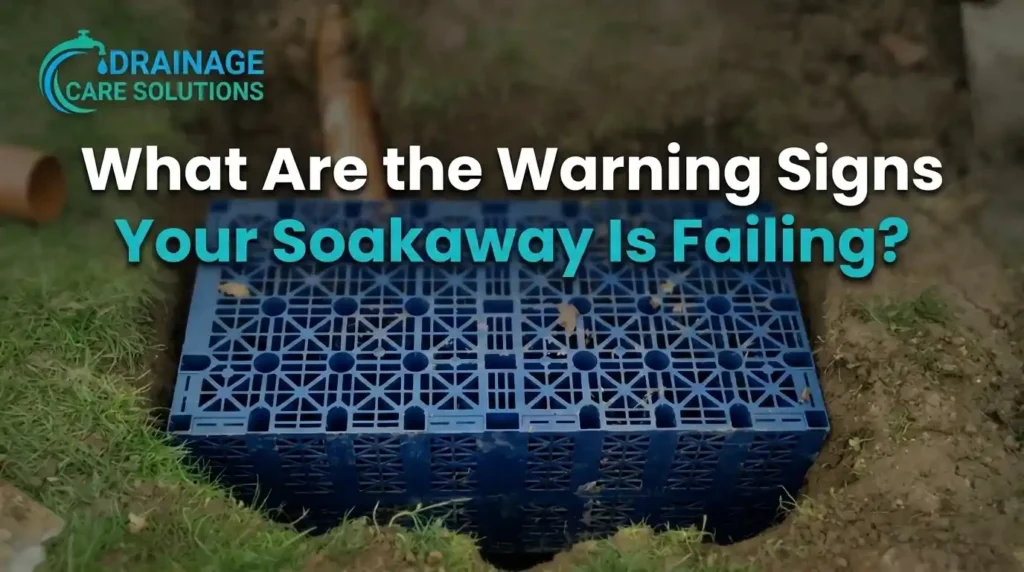
A homeowner in Southbourne told us their back garden had flooded “every winter for three years.” Two contractors had jetted the lines and charged for it. The high-pressure jetting made things worse. When we ran a percolation test and dug an inspection pit, the truth showed immediately. The 1970s rubble pit soakaway had silted up solid, a process engineers call blinding. The ground had simply stopped drinking water.
That’s the nature of soakaway failure signs. They build slowly and whisper before they shout. By the time you need wellies to reach the car, the drainage system has usually been struggling for a year or more. This guide helps UK homeowners and landlords spot the early soakaway problems before a boggy lawn becomes a foundation problem.
How Do I Know If My Soakaway Is Blocked?
You know your Soakaways in Bournemouth are blocked when water pools above them long after rain stops, the ground stays soft and spongy underfoot, connected drains and gullies empty slowly, and dips appear in the lawn. A working soakaway disperses surface water invisibly. The moment you start noticing it, something has gone wrong with the system.
Quick Self-Check Symptom Audit
Run through these soakaway failure signs before calling anyone:
- Standing water above the soakaway 24 to 48 hours after rain.
- Spongy ground that never fully dries.
- Sunken dips from soil compaction.
- Slow-draining gutters, downpipes, and gullies.
- Lush green patches of unusually vigorous grass.
- Gurgling from indoor drains after heavy rain.
Three or more matches strongly suggest a failing soakaway system rather than a passing wet spell.
Why Is Water Pooling in My Garden?
Water pools in your garden when the soakaway can no longer disperse water into the surrounding subsoil fast enough. This happens through siltation of the soakaway crates or pit, compacted soil reducing percolation, a collapsed feed pipe, or a soakaway that was undersized at installation. Surface pooling is the most visible of all soakaway failure signs.
The Most Common Causes of Pooling
- Siltation: Fine sediment washes in and seals the voids like a plug.
- Compaction: Surrounding soil hardens and stops absorbing.
- Undersizing: The soakaway is too small for the roof catchment it serves.
- Pipe collapse: The pipe between gully and soakaway has failed.
In Bournemouth’s sandy soils, garden drainage problems often signal a high winter water table rising to meet the soakaway, leaving discharged water nowhere to go.
Why Is My Garden Always Waterlogged?
Your garden stays permanently waterlogged when the soakaway has reached the end of its working life and the soil around it has become saturated and impermeable. Old rubble pit soakaways suffer from blinding, where silt fills every void and turns the pit into a sealed, concrete-like shell. No water moves through it at all.
Why DIY Fixes Fail Here
High-pressure jetting is excellent for sewers and blocked drains. On a failing soakaway it is often destructive. Forcing water through compacted silt drives the particles deeper and accelerates total collapse. This is one of the most expensive mistakes we see homeowners make when reacting to waterlogged garden drainage without a proper diagnosis first.
A CCTV drain survey and percolation test reveal whether the problem is the pipework, the pit, or the surrounding ground before any excavation begins.
Why Is My Soakaway Backing Up Into My House?
A soakaway backs up into your house when the system is so overwhelmed that water reverses through the drainage under hydrostatic pressure. This is one of the most serious soakaway failure signs and usually means the system has failed completely rather than partially. A soakaway backing up indoors needs urgent professional attention.
What Backup Indicates
- The soakaway is at or beyond full capacity.
- A connected pipe has collapsed and reversed flow.
- The water table has risen above the soakaway level.
- The system was wrongly connected to foul water drainage.
Internal flooding risks contamination and damage to floors and skirting. Treat any sewage backup as an emergency.
What Should I Do If My Soakaway Smells Bad?
If your soakaway smells bad, the cause is almost always stagnant water and decomposing organic matter trapped in a system that can no longer drain. Foul, earthy, or rotten-egg odours near the soakaway are clear soakaway failure signs that the system is holding water rather than dispersing it. A bad smell from a soakaway rarely clears on its own.
Steps to Take
- Do not pour chemical drain cleaners into the system.
- Check whether the smell worsens after rain.
- Note whether nearby gullies are slow to clear.
- Book a professional soakaway inspection rather than masking the odour.
A bad smell combined with surface water almost always confirms a system holding stagnant water. Where the soakaway serves a septic tank or sewage treatment plant, untreated effluent backing up needs immediate attention.
Can a Blocked Soakaway Cause Foundation Problems?
Yes, a blocked soakaway can cause serious foundation problems over time. Saturated subsoil loses its load-bearing strength, leading to ground movement, subsidence, and cracking in nearby walls, patios, and driveways. This is the most damaging and most overlooked of all soakaway failure signs.
How the Damage Develops
Water that cannot disperse saturates the ground around your foundations. Saturated subsoil compacts and shifts. Supporting material is lost. Then the visible damage appears:
- Diagonal cracks in brickwork near the soakaway.
- Sloping or cracking patios and driveways.
- Leaning fence posts and garden structures.
- New cracks climbing interior walls after heavy rain.
Building Regulations Part H require soakaways to sit at least five metres from any building precisely to prevent this. A damaged soakaway too close to the house puts your foundations at direct risk.
How Can I Tell If My Soakaway Needs Replacing Soon?
Your soakaway needs replacing soon when problems return within weeks of clearing, when the pit has silted solid, when the system predates modern crate design, or when a percolation test shows the surrounding soil no longer absorbs water. Repeated soakaway failure signs after maintenance point to replacement rather than repair.
Soakaway Replacement Warning Signs
- Flooding returns within weeks of clearing.
- The system is an old rubble or brick pit rather than modern crates.
- Percolation testing shows poor or no absorption.
- The feed pipework has collapsed.
- The system was undersized from installation.
Modern soakaway crates wrapped in non-woven geotextile membrane last decades when correctly installed and sized. Old rubble pits eventually fail without exception.
A Homeowner’s Guide to Diagnosing What’s Wrong With Your Soakaway
Most soakaway failure signs trace back to one of four causes: siltation, soil compaction, collapsed pipework, or undersizing. The only reliable way to identify which applies is a proper assessment combining a percolation test, an inspection pit, and a CCTV survey of the connecting drainage.
The honest answer most homeowners need to hear is this. Reacting to soakaway drainage issues with repeated jetting or chemical treatments wastes money and often worsens the damage. A correct diagnosis first saves you paying twice.
If your garden is flooding, smelling, or staying waterlogged, get it assessed properly. Drainage Care Solutions provides honest soakaway diagnostics across Bournemouth, Poole, Christchurch, and the BH postcode area. Call us or book a drainage assessment today.
Common Questions About Soakaway Failure Signs Answered
How Long Does a Soakaway Last in the UK?
A traditional rubble pit soakaway lasts around 25 to 35 years in clay soils, though many fail sooner through siltation. Modern crate systems wrapped in geotextile membrane can last over 50 years when correctly installed and sized. In sandy Bournemouth soils, lifespan depends heavily on the winter water table and installation quality.
Is A Failing Soakaway Covered by Home Insurance?
Some UK home insurance policies cover soakaway damage where it results from accidental damage, such as crushed pipework. Gradual failure, siltation, and wear are usually excluded as maintenance issues. Soakaway failure signs caused by age rarely qualify. Check your policy wording and guidance from the Association of British Insurers and keep any CCTV survey report as supporting evidence.
Can I Unblock a Soakaway Myself?
You can clear connecting gullies and silt traps yourself, but a genuinely blocked soakaway almost always needs professional excavation. Avoid high-pressure jetting, which compacts silt and accelerates collapse. If blocked soakaway symptoms return after basic clearing, the pit or pipework needs proper assessment rather than repeated DIY attempts.
Do I Need Permission to Replace a Soakaway?
A like-for-like soakaway replacement usually falls under permitted development. New installations must meet Building Regulations Part H, sit at least five metres from buildings, and follow a BRE 365 percolation test confirming the soil drains adequately. Building Control sign-off is required for new soakaway systems serving foul drainage.
How Much Disruption Does Soakaway Replacement Cause?
Soakaway replacement involves excavation, so expect garden disruption around the work area for one to two days for a standard domestic system. Access, soil conditions, and system size affect the timeline. A proper assessment confirms the scope before work starts, so you can plan around it rather than face surprises.