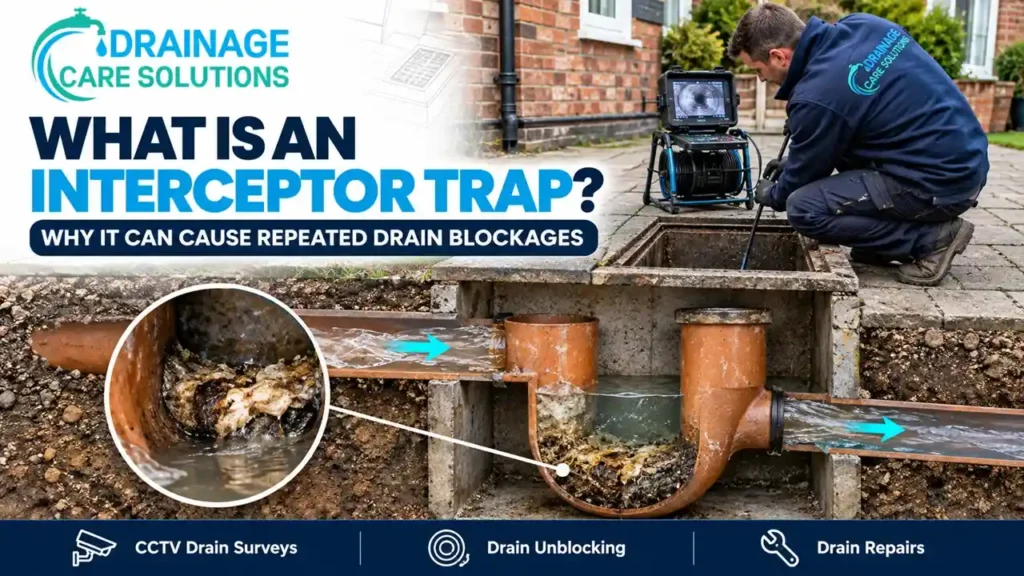
An interceptor trap blockage can develop when waste, sludge or other material collects within the curved section of an older underground foul-drain fitting. Often called a Buchan trap, intercepting trap or disconnecting trap, it contains a permanent water seal and is commonly associated with the later part of an older property’s drainage system.
The shape that creates this water seal can also create a restriction point. Wastewater has to travel through a bend rather than along a straight pipe, so accumulated material can gradually reduce the available opening. That does not mean every interceptor is defective, or that an old trap should automatically be removed.
What Is an Interceptor Trap?
An interceptor trap is a fitting within underground foul drainage that contains a U-shaped or similarly curved section. Water remains in the bottom of this bend, forming a seal between the property’s drainage and the pipework leading onwards towards the sewer.
Older examples are often associated with clay or fireclay drainage and may sit within or immediately beside an inspection chamber. Depending on the age of the system and the terminology used on old plans, the fitting might be labelled as a Buchan trap, intercepting trap, disconnecting trap, sewer trap or drainage interceptor.
Its basic arrangement can be pictured as:
property drain → inspection chamber → water-filled trap → onward sewer connection
The retained water is part of the design. Seeing water inside the bend does not, by itself, mean that the trap is blocked.
Why Were These Traps Used in Older Drainage Systems?
Interceptor traps formed part of older foul-drainage arrangements intended to maintain a water seal between sections of the drainage system. This helped limit the movement of foul air from the sewer towards private drainage.
They have also been used as part of older rodent-control arrangements. Current Approved Document H still discusses intercepting traps within its guidance on special protection against rodents, but it also highlights their practical limitation: they can be susceptible to blockage and need maintenance.
Modern drainage design does not mean every surviving Buchan trap must be removed. Some older installations continue to function satisfactorily, so the condition and behaviour of the actual drainage system matter more than the age of the fitting alone.
Where Is an Interceptor Trap Usually Found?
Not every older UK home has an interceptor, and property age alone cannot confirm that one is present. Where a trap does exist, it is commonly associated with a later inspection chamber along the private foul-drain run, sometimes close to the property boundary or connection towards the sewer.
An old drainage drawing may show the arrangement, but the actual chamber layout is generally more useful. A homeowner may first discover the fitting when a chamber is opened during investigation of a recurring blockage.
Typical clues include:
- a water-filled curved outlet at the base of the chamber
- a separate higher cleaning or rodding opening
- old clay drainage entering or leaving the chamber
- reference to a Buchan, disconnecting or intercepting trap on historical plans
For an active drainage problem in Bournemouth, the appropriate first step is usually to establish the location of the restriction rather than assuming that an interceptor is present. Drainage Care Solutions confirms that recurring blocked drains may require further investigation where ordinary clearance does not provide a lasting result.
Why Can an Interceptor Trap Block Repeatedly?
The important part is the change in the flow path.
Wastewater travelling through a relatively straight underground drain reaches the interceptor and has to pass down through the water seal, around the curved section and back up into the onward pipe. Any material that does not move freely through this change of direction can begin to collect.
Stage 1: A Small Deposit Forms
Sludge, grit, wipes or another obstruction may reduce the opening slightly. Wastewater can still pass, so the problem may not initially be obvious.
Stage 2: Flow Becomes More Restricted
The smaller opening makes it easier for additional waste to catch. Material that might have travelled through a clear trap can now become attached to the existing deposit.
Stage 3: The Upstream Drain Backs Up
Eventually, the remaining opening is too small to carry normal wastewater flow. The inspection chamber and pipework upstream begin to fill.
This is why an interceptor trap blockage can sometimes return after the drain has apparently been cleared. If only enough obstruction is removed to restore flow, material left behind may start collecting waste again.
For other causes outside the interceptor itself, Drainage Care Solutions has a separate guide explaining why the same drain keeps blocking. The live page correctly distinguishes clearing a blockage from identifying the reason it formed.
What Can Become Trapped Inside It?
An interceptor does not manufacture waste. Problems arise when unsuitable material or existing deposits encounter a restricted, curved section of drainage.
Wet wipes and sanitary products: These do not disperse as readily as ordinary toilet paper and can catch on existing deposits or irregular surfaces.
Sludge, silt and grit: Heavier material can settle in slower-moving parts of old drainage and gradually reduce the usable opening.
Fat and grease: Where kitchen wastewater enters the same foul system, deposits can combine with other material and contribute to a narrowing of the flow route.
Foreign material: Stones, broken components or other debris may sometimes be present in older chambers and pipework.
Roots: Root ingress can occur through defective joints or damaged pipework close to the trap. Roots should not be assumed to have simply penetrated sound clay without an existing route of entry.
Real UK homeowner discussions show this pattern in practice. One recent Reddit thread involved a frequently blocking Buchan trap where substantial stones and debris were eventually removed from the U-bend, after which the repeated obstruction reportedly stopped. That is an individual experience rather than proof that all repeat blockages have the same cause, but it reflects the type of problem homeowners actively ask about.
What Is the Rodding Eye on an Interceptor?
Many interceptor arrangements include an additional access route intended to make the drainage beyond the water-filled trap easier to reach for maintenance.
This may appear as a separate higher opening fitted with a removable stopper or cap. Approved Document H specifically refers to intercepting-trap stoppers and says they should be removable from the chamber surface for blockage clearance and securely replaceable afterwards.
A missing, damaged or displaced stopper can therefore be relevant to an inspection. However, a homeowner should not assume that an unidentified object found inside an old chamber is rubbish, nor attempt to force it into an opening without understanding the drainage layout.
What Do Different Warning Signs Actually Tell You?
Surface symptoms can narrow down the investigation, but few of them identify the interceptor on their own.
| Finding | Possible Meaning | Does It Confirm the Interceptor? |
| Chamber immediately upstream is full | Restriction somewhere downstream | No |
| Debris visibly fills the trap | Local obstruction is likely | Strong indication |
| Several fixtures drain slowly | Main foul-drain restriction possible | No |
| Same point blocks repeatedly | Persistent local restriction possible | Investigation needed |
| Camera cannot pass the bend | Trap geometry or obstruction | No |
| Roots appear near the chamber | Nearby drainage defect possible | No |
| Downstream chamber is also full | Problem may lie farther downstream | No |
The key diagnostic question is therefore not simply, “Is there an interceptor?” It is, “Where does normal wastewater flow stop?”
How Can You Confirm Whether the Interceptor Is Causing the Problem?
A proper investigation should narrow down the restriction before alteration or structural work is recommended.
1. Locate the Relevant Chambers
The drainage route is established as far as reasonably possible. Water levels in accessible chambers can help show which part of the system is backing up.
2. Compare Upstream and Downstream Flow
If wastewater accumulates immediately before the trap while drainage beyond it remains clear, the interceptor becomes a stronger suspect. If another downstream chamber is also full, the problem may be farther along the system.
3. Assess the Trap and Its Access
Visible debris, condition of the rodding access and the physical state of the chamber can provide further evidence. Clearance may be needed before all relevant components can be seen properly.
4. Inspect Connected Pipework Where Necessary
Where the source remains uncertain, CCTV inspection of the underground drain may identify roots, displaced joints, cracks or other defects in accessible pipework. Drainage Care Solutions’ current CCTV service confirms that camera inspection is used for recurring or unexplained drainage faults that cannot be established through visual assessment alone.
This sequence keeps the diagnosis evidence-led. The presence of an old trap is not enough reason to recommend its removal.
Can CCTV Pass Through a Buchan Trap?
Sometimes it can, but it should not be assumed.
The curved section, standing water and physical dimensions of an interceptor can restrict the movement or view of a push-rod camera. Some designs may prevent the camera travelling directly through the trapped section altogether.
That limitation does not make CCTV useless. Accessible pipework can sometimes be approached from another inspection chamber or entry point, allowing the drainage before or beyond the interceptor to be checked for structural defects or another obstruction.
A camera failing to pass through the trap is therefore an access finding, not automatic evidence that the trap itself has failed.
Clean It, Repair It or Remove It?
These are three separate decisions, and the correct one depends on what the investigation actually finds.
Cleaning Makes Sense When the Trap Is Sound
If an otherwise serviceable interceptor contains removable deposits or lodged waste, professional clearance may restore normal flow. What happens afterwards is important. If the problem does not return, substantial alteration may not be justified.
Repair Becomes Relevant When Something Is Damaged
A broken connection, damaged chamber, displaced fitting or root-affected joint can create a snag point close to the interceptor. In that case, repairing the defect may address the reason material repeatedly catches.
Removal Is a Wider Drainage Decision
Alteration or removal may be considered where a trap has been confirmed as a persistent serviceability problem, is seriously damaged or forms part of wider drainage works.
It should not be treated as a simple DIY modification. The surrounding drainage layout, ventilation, sewer connection, maintenance access and Building Regulations can all be relevant.
Does Every Old Interceptor Need Removing?
No. An interceptor that remains in good condition and allows the drainage system to operate normally does not automatically require removal simply because the design is old.
A better decision considers how frequently the trap blocks, whether the same point is repeatedly confirmed as the restriction, whether the fitting is damaged and whether maintenance access is practical. Age is supporting context, not a diagnosis.
This distinction also prevents unnecessary work. Replacing a functioning interceptor would not solve a restriction that actually lies farther downstream.
Could the Real Blockage Be Beyond the Interceptor?
Yes, and this should be ruled out before changing the trap.
A downstream pipe can contain roots, a displaced joint, heavy deposits, deformation or a collapsed section. Any of those conditions can cause wastewater to back up into the chamber immediately before the interceptor, making the trap look responsible when it is simply where the backed-up water becomes visible.
Where structural failure is suspected, the separate Drainage Care Solutions guide covers signs of a collapsed underground drain. This keeps a serious pipe failure separate from an interceptor-specific restriction.
What Can You Safely Check Before Calling a Drainage Engineer?
Homeowners can collect useful information without attempting to work inside the drainage system. Note whether one fixture or several fixtures are affected, which accessible chamber first becomes full and how quickly the blockage returns after previous clearance.
Old plans can also be useful if they mention an interceptor, Buchan trap or disconnecting trap. Tell the drainage engineer if the same location has previously caused problems or if another contractor has already identified the fitting.
Do not enter an inspection chamber, reach into foul water, operate high-pressure drainage equipment or force rods through unknown old pipework. Those activities add contamination risks and can make an existing drainage problem more difficult to assess.
What Does Official UK Guidance Say?
The strongest regulatory reference is Approved Document H: Drainage and Waste Disposal.
Current guidance states that intercepting traps are susceptible to blockage and require frequent maintenance. It also addresses removable locking stoppers intended to allow blockage clearance from the chamber surface.
That supports a balanced conclusion. Interceptor traps deserve attention as possible restriction points, but official guidance does not mean that every old interceptor is currently blocked or should automatically be removed.
FAQs
What Is an Interceptor Trap?
An interceptor trap is an older underground foul-drain fitting containing a permanent water seal. It is often associated with a later inspection chamber before private drainage continues towards the sewer.
Is a Buchan Trap the Same as an Interceptor Trap?
Buchan trap is a commonly used name for this type of intercepting or disconnecting trap. Terminology varies between older plans, regions and technical sources.
Why Do Interceptor Traps Keep Blocking?
Their water-filled bend creates a more restricted flow path than a straight drain. Sludge, wipes, grit or other material can collect there and gradually reduce the opening available for wastewater.
How Do I Know if I Have an Interceptor Trap Blockage?
Repeated backup immediately upstream of the trap, visible obstruction within it or repeated clearance at the same point can make the interceptor a strong suspect. These signs should still be distinguished from a blockage farther downstream.
Can an Interceptor Trap Be Cleaned?
Often, yes. Accessible waste and deposits may be cleared professionally, but whether cleaning provides a lasting solution depends on why the obstruction formed and the physical condition of the trap.
Can CCTV Inspect an Interceptor Trap?
A camera may inspect accessible pipework around the interceptor, but the water-filled bend can restrict or prevent passage through the fitting itself. Another access point may sometimes be required.
Should an Old Buchan Trap Be Removed?
Not automatically. Removal becomes more relevant where the trap has been confirmed as a recurring restriction, is damaged or needs to be altered as part of wider drainage work.
Confirm the Restriction Before Changing an Old Drain
An interceptor trap blockage should be investigated as a specific drainage restriction rather than treated as proof that the whole old system needs alteration. A trap containing accumulated debris may only need suitable clearance, while structural damage nearby could justify repair. If repeated investigation confirms that the trap itself continues to create serviceability problems, alteration can then be considered in the context of the wider drainage system.
Drainage Care Solutions provides blocked-drain and CCTV investigation services for homeowners, landlords and businesses in Bournemouth and surrounding areas. Where an interceptor or Buchan trap may be involved, the sensible objective is to identify the actual restriction before recommending cleaning, repair or alteration.
For a recurring drainage problem, property owners can contact Drainage Care Solutions with details of the symptoms and any previous information about the drainage layout.