To clean rainwater drains, lift accessible grates and remove leaves, twigs and loose debris by hand, then scoop visible silt from the gully pot into a bucket instead of washing it into the pipe. Finish by running a little clean water through and watching whether it drains normally. If it does not, the restriction may lie deeper underground.
This guide explains how to clear a rainwater drain and gully safely, using only the parts you can reach. It does not cover kitchen wastewater gullies, road gullies or underground pipework, which need a different approach.
Where Do Rainwater Drains and Gullies Become Blocked?
A rainwater gully is the inlet that collects surface water, while the rainwater drain is the pipe carrying it away. A restriction can sit at the grate, inside the pot, or in the connecting pipe.
| What You Can See | Possible Cause | Next Step |
| Leaves covering the grate | Surface debris | Remove the loose material |
| Silt sitting in the gully | Sediment accumulation | Clear accessible material safely |
| Water still not draining after cleaning | Deeper restriction | Arrange further investigation |
| Water held in a trapped gully | Normal water seal possible | Check before assuming a blockage |
| Overflow only in exceptional rainfall | Restriction or capacity exceeded | Reassess when conditions improve |
Treat the table as a guide, not a diagnosis. A leaf-covered grate can hide a silted pot, and a clear gully can still feed a restricted pipe.
How to Clean a Rainwater Drain Safely
Work only on gullies you can reach safely on your own property. Wear sturdy gloves, keep a bucket beside you, and never push material through the grate into the pipe.
- Confirm the gully serves rainwater, such as a downpipe outlet or driveway channel, not kitchen or bathroom wastewater. If unsure, leave it alone.
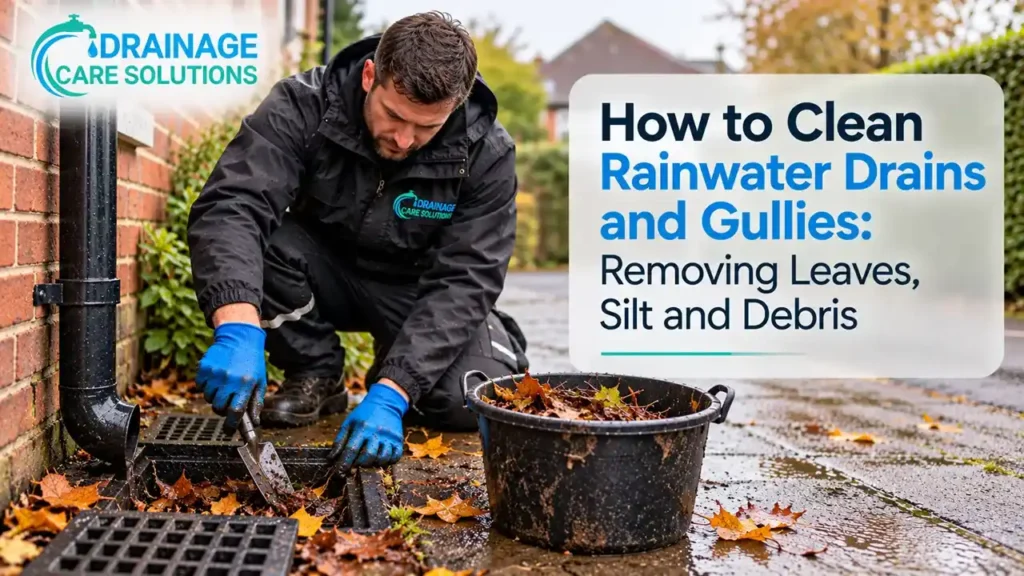
- Lift the grate where it lifts freely, and clear leaves, twigs and litter by hand or with a trowel. Do not force a seized grate.
- Look into the gully pot for silt, grit and decomposed leaves below the surface. Only deal with material you can see and reach.
- Scoop loose silt and debris into a bucket for garden or household waste. Do not wash it down the outlet, where it can settle again.
- If the gully is not already overflowing, run a little clean water through and watch whether it drains normally. Stop if water backs up or rises.
- If the grate and pot are clear but water still drains slowly, the restriction is likely further downstream. That is the point to stop trying to unblock a rainwater drain yourself and arrange investigation.
Do not pour chemical cleaners into a surface-water drain, or use rods or jetting equipment on unseen pipework. Chemicals can reach watercourses, and a forced rod can damage joints.
Why Do Leaves, Silt and Debris Build Up in Rainwater Gullies?
Autumn leaf fall is the biggest single source: leaves wash from roofs and gutters down the downpipe, or blow across patios and driveways onto a grate, where moss, grass cuttings and twigs add to the mat. Once the grate is partly covered, finer material collects underneath.
Soil and grit arrive with surface runoff. Rain carries loose garden soil, sand and driveway material into the gully, where heavier particles sink and form silt build-up in the pot. In dry spells that sediment crusts, and in wet spells decomposing leaves break down into sludge that narrows the outlet. If build-up keeps returning, professional outside drain clearance can remove the deeper material.
Does Standing Water in a Rainwater Gully Mean It Is Blocked?
No. Some gullies are trapped gullies, designed to hold a small amount of water as a seal. The outlet sits higher than the base of the pot, so a shallow pool after rain can be entirely normal, and not every gully has a silt trap.
Standing water becomes a concern when the level is unusually high, when water overflows during ordinary rain, or when flow stays poor after cleaning. Those signs point to a restriction at the outlet or further downstream.
Why Is My Rainwater Drain Still Blocked After Cleaning?
A clean gully pot does not guarantee a clear pipe. Sediment may sit beyond the accessible gully, a joint may have moved, roots may have entered through a defect, or the pipe may be damaged. The run may lead to a surface water sewer or a soakaway, and where sediment has travelled that far, how silt affects soakaway performance explains why the downstream end can fail.
Saturated ground and exceptional rainfall can also slow drainage without anything being broken. If poor flow persists once conditions ease, the cause is hidden underground, and a CCTV inspection of underground drains can show whether it is sediment, a defect or a further restriction.
How Often Should Rainwater Drains and Gullies Be Cleaned?
For routine rainwater gully cleaning, no single frequency suits every property: leaf fall, nearby trees, soil runoff and gutter condition all differ. Use the season and what you can see as your guide, rather than a fixed date.
- Check gullies frequently through autumn, when leaves accumulate fastest.
- Inspect grates after storms, when fresh debris washes in.
- Monitor gullies near soil, moss and patio runoff all year.
- Investigate why the same gully blocks repeatedly.
The simplest answer to how to stop leaves blocking drains is routine: gutters cleared before leaf fall, grates checked through autumn. A gully cleared every few weeks is telling you something: debris outpaces the outlet, or a deeper restriction is narrowing the flow.
When Should You Call a Professional Drainage Company?
Call for help when water keeps overflowing, when a blocked rainwater gully overflows again soon after cleaning, when water backs up after surface cleaning, or when you suspect an underground obstruction or damaged pipework. Significant sediment, inaccessible parts and anything unsafe mean handing the job over.
Professional Clearance
For persistent problems, Drainage Care Solutions provides professional outside drain clearance to remove a deeper obstruction. Clearance deals with the blockage, not with finding a hidden cause.
When a Camera Survey Helps
A CCTV survey is only needed where the cause is hidden, structural or keeps returning. A simple surface blockage needs neither.
Keeping Rainwater Drains Clear in Bournemouth
Most rainwater gully problems start small: a grate covered after a windy weekend, or silt building through a wet autumn. Seasonal checks, bagged debris and early action prevent most overflow before it reaches a patio or doorway.
If a rainwater gully still overflows after accessible leaves and debris have been cleared, Drainage Care Solutions can help investigate private surface water drainage problems in Bournemouth and surrounding areas. Professional clearance or CCTV inspection may suit a deeper restriction. Road gullies are not yours to clear: flooding on public roads is reported to the council, while private drains remain the owner’s responsibility (BCP Council flooding reports).
Frequently Asked Questions
Short answers to common rainwater drain cleaning questions.
How Do You Clean a Rainwater Drain?
To unblock a gully drain, lift accessible grates, remove leaves and debris by hand, scoop visible silt into a bucket, and test flow with clean water. Stop and arrange investigation if water still does not drain normally.
How Do You Remove Leaves From an Outside Drain?
For a drain full of leaves, lift the grate where it lifts freely and clear leaves, twigs and litter by hand or with a trowel, wearing sturdy gloves. Bag the material, then replace the grate securely.
How Do You Clear Silt From a Rainwater Gully?
Clear silt from a rainwater gully by scooping loose sediment from the accessible pot into a bucket for garden or household waste. Do not wash silt down the outlet, or reach into deep chambers.
Can a Blocked Rainwater Drain Cause Flooding?
A blocked rainwater drain can cause localised flooding around patios, driveways and door thresholds when heavy rain has nowhere to go. Early clearing reduces that risk, but flooding from a public sewer or watercourse belongs to the responsible authority.
When Should I Call a Drainage Engineer?
Call a drainage engineer if water still does not drain after accessible cleaning, if the same gully keeps blocking, or if you suspect damage, root ingress or a downstream restriction. Camera inspection is worth considering where the cause is hidden.