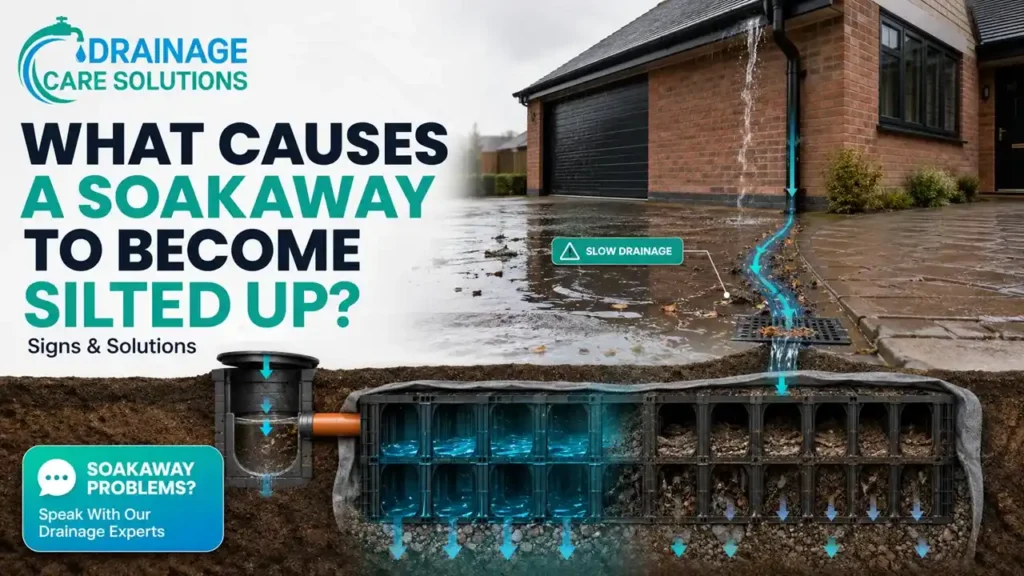
A silted soakaway develops when soil particles, grit, sand, organic material and other fine sediment travel through surface-water drainage and gradually settle where rainwater should be stored or infiltrated. As deposits increase, the system may empty more slowly, connected gullies may back up and standing water can appear after rainfall.
Siltation is only one possible cause. Saturated ground, damaged pipework, inadequate infiltration or structural failure can create similar symptoms, so the location of the restriction needs to be established before deciding on cleaning or replacement.
Follow the Sediment: How Soakaway Siltation Begins
Silt does not usually appear inside a soakaway without a route into the system. Rainwater collects material as it travels across roofs, driveways, patios, gardens and other surfaces before reaching gullies or inlet pipes.
The amount carried during one rainfall event may be small. The problem develops when repeated sediment loading allows material to settle faster than it is intercepted or removed.
Roof Runoff Can Carry More Than Water
Moss fragments, fine grit, leaf debris and decomposed organic material can collect in gutters and roof drainage. During rain, smaller particles may travel through the downpipe towards the surface-water system.
Keeping roof drainage clear therefore helps reduce material entering downstream components, although it cannot prevent every fine particle from reaching them.
Hard Surfaces Create a Different Sediment Load
Driveways, patios and yards may contribute sand, soil, road grit, loose jointing material and other debris.
This is particularly relevant where surface runoff passes directly towards a channel drain or gully before entering the soakaway system.
Building and Landscaping Work Can Change the Pattern
Excavation, landscaping and new hard surfaces can disturb soil that was previously stable. Rainfall can then wash fine material into nearby drainage.
Modern UK SuDS standards recognise sediment control as part of protecting drainage performance and specifically require maintainable measures where deposited sediment could otherwise affect a system.
What a Silted Soakaway Actually Means
The term can describe several related problems. Sediment does not necessarily have to fill the main soakaway chamber before drainage performance changes.
Think of the system as having three possible restriction zones.
Before the Soakaway
Material can settle in a gully, catchpit, inspection chamber or connecting pipe.
If this happens, the buried infiltration structure may still be working correctly. Rainwater simply cannot reach it quickly enough.
Inside the Storage Area
Fine deposits can occupy spaces designed to hold water temporarily. In an older rubble-filled system, this may mean voids between aggregate. In a modern geocellular system, sediment may affect accessible storage or inlet areas.
Less useful storage can mean the system reaches capacity more quickly during rainfall.
At the Infiltration Interface
Water eventually has to move from the soakaway into the surrounding ground. Fine sediment can contribute to clogging at filtration and infiltration surfaces, reducing how easily that movement occurs.
This is one reason current National Standards for Sustainable Drainage Systems specify pre-treatment to protect infiltration surfaces from clogging.
Where the underlying cause cannot be established from accessible drainage alone, professional soakaway repair and replacement should follow investigation rather than an assumption that the complete system has failed. Drainage Care Solutions currently provides this service for homeowners, landlords and commercial properties in Bournemouth.
Why Does the Drainage Usually Get Worse Gradually?
Soakaway siltation is often progressive.
A small quantity of sediment may have little noticeable effect. As more material settles, however, water can lose storage space, inlet pipes can become restricted and infiltration surfaces may become less effective.
This can explain why a system that previously cleared rainfall without an obvious problem starts taking progressively longer.
A silted soakaway may therefore still accept some water. Reduced performance is not the same as total blockage.
Could the Inlet Be the Real Problem?
Yes. This possibility deserves checking before the soakaway itself is blamed.
Sediment tends to settle where water slows down. Gullies, pipe bends, chambers and catchpits can therefore accumulate deposits before water reaches the infiltration structure.
If clearing an upstream restriction restores normal flow and the soakaway then empties adequately, major work to the soakaway may not be necessary.
Conversely, if the inlet is clear but water remains at a high level within the system, investigation needs to move further downstream.
Siltation or Saturated Ground: How Are They Different?
Both can produce slow drainage and standing water, which makes them easy to confuse.
A Pattern More Consistent with Siltation
Suspicion increases where performance has deteriorated gradually and there is physical evidence of sediment elsewhere in the drainage system.
Frequently filled silt traps, visible deposits in accessible chambers or repeated restrictions in the inlet route can all help build that picture.
A Pattern More Consistent with Ground Saturation
The surrounding ground may simply have limited capacity to accept more rainwater during prolonged wet conditions.
If drainage problems occur mainly after extended rainfall and improve significantly once the ground has had time to dry, saturation may be contributing.
Drainage Care Solutions’ guide to how prolonged rainfall affects drainage systems provides further context on how wet conditions can affect drainage behaviour.
Neither pattern alone confirms the diagnosis. Ground conditions, system capacity and pipe condition may all interact.
Read the Pattern Before Choosing the Remedy
Instead of assigning one symptom to one fault, compare several findings.
| What Is Found | What It Could Suggest | Sensible Direction |
| Sediment only in an accessible gully | Local accumulation | Clean and monitor |
| Silt trap repeatedly filling | High sediment entering the system | Find the upstream source |
| Restricted connecting pipe | Material collecting before the soakaway | Clear and inspect the pipe |
| Drainage becoming progressively slower | Reduced storage or infiltration possible | Assess the system |
| Problems mainly during prolonged wet periods | Ground saturation may contribute | Review ground conditions |
| Poor performance returns soon after cleaning | Deeper restriction or infiltration issue possible | Broader assessment |
These are diagnostic clues, not fixed rules. The separate guide to other warning signs of soakaway failure covers the wider causes and symptoms of failing systems.
Can a Silted Soakaway Be Cleaned?
Sometimes. Cleaning is most realistic when the sediment is accessible and the infiltration system beyond it remains functional.
A silt-filled gully, catchpit or inlet pipe is very different from fine material embedded across a difficult-to-access infiltration surface.
Where Cleaning May Help
Removing deposits from accessible drainage can restore flow where the restriction is local. Maintenance of silt traps and catchpits can also stop captured sediment progressing farther into the system.
High-pressure jetting may sometimes suit connecting pipework, depending on the pipe condition and the nature of the deposit.
It should not be assumed that forcing material farther towards the soakaway will improve infiltration.
Where Cleaning May Not Be Enough
If the available storage has become heavily contaminated with fine material or the infiltration surface is extensively clogged, accessible cleaning may have limited effect.
Repeated short-term improvement followed by another rapid decline can also indicate that the underlying issue has not been addressed.
At that point, rehabilitation, targeted repair or replacement may need to be considered according to the actual condition found.
Modern Crates and Old Rubble Pits Do Not Clog in Exactly the Same Way
Construction affects both the sediment pathway and the options available later.
Modern Geocellular Systems
Modern soakaways may use modular crates, geotextile layers, clean backfill, inlet pipework and sediment-control components.
The geotextile has an important filtration and separation role, while upstream silt management helps protect the infiltration area. Current government standards also call for drainage designs to provide accessible sediment-control systems where clogging could affect performance.
The Drainage Care Solutions guide to components used in modern soakaways explains how crates, membranes, pipework and silt-control components fit together.
Older Rubble-Filled Soakaways
An older system may rely on voids around rubble or aggregate to store incoming rainwater.
Fine sediment can gradually occupy some of those spaces. Inspection and rehabilitation may also be more difficult where there is limited access into the original construction.
That does not mean every old rubble soakaway is defective. Performance and surrounding ground still need assessing.
How Can Future Silt Build-Up Be Reduced?
The most useful strategy is to reduce sediment before it reaches difficult-to-maintain parts of the system.
Practical measures include:
- Keep gutters and roof outlets reasonably clear of accumulated moss and debris.
- Maintain accessible gullies, catchpits and silt traps.
- Prevent loose soil and muddy runoff entering drainage during landscaping or construction where practicable.
- Keep intended inspection points accessible.
- Investigate why silt traps are filling unusually quickly instead of repeatedly emptying them without addressing the source.
These measures reduce sediment loading but cannot guarantee that the drainage system will never develop another problem.
When Does Professional Investigation Become More Useful Than Repeated Cleaning?
Repeatedly removing visible silt is unlikely to be efficient if the same drainage problem quickly returns.
Professional assessment becomes particularly useful where the inlet drainage appears clear but the soakaway remains slow, visible deposits keep returning, flooding starts occurring more readily or the condition of the underground system is uncertain.
A drainage engineer can work from accessible upstream components towards the soakaway, consider the water level and pipe condition, and assess whether surrounding infiltration needs further investigation.
CCTV can assist with accessible connecting pipework or internal areas that can actually be viewed. It cannot directly establish how well the surrounding soil absorbs water.
Questions Homeowners Ask About Soakaway Siltation
What Causes a Soakaway to Become Silted Up?
Fine soil, sand, grit and organic debris can travel with surface runoff and settle in drainage pipes, storage areas or filtration surfaces. Repeated accumulation can gradually reduce drainage performance.
How Do I Know if Silt Is the Problem?
Visible sediment in gullies or chambers, repeatedly filling silt traps and gradually worsening performance can support suspicion of siltation. They do not prove it because saturated ground and drainage defects can produce similar symptoms.
Can a Silted Soakaway Be Unblocked with Jetting?
Jetting may help with some accessible pipe restrictions, but it is not a universal method for restoring a clogged soakaway. The location of the sediment should be identified first.
Does a Silted Soakaway Need Replacing?
Not automatically. Local deposits may be cleanable, while more extensive clogging, structural problems or poor surrounding infiltration can make larger remedial work necessary.
Can Modern Soakaway Crates Still Become Clogged?
Yes. Modern components can improve sediment management, but adequate pre-treatment, filtration and maintenance are still relevant to protecting infiltration performance. Current UK SuDS standards specifically address the need to reduce clogging risk.
Why Does My Soakaway Fill Quickly After Rain?
Silt may be reducing available storage or infiltration, but the system could also be receiving more water than it can manage, the ground may be saturated or an inlet or structural problem may exist.
Use Sediment Control to Protect Infiltration
A silted Soakaway is ultimately a sediment-management problem, but the sediment may be sitting in the inlet drainage, within the storage system or around the infiltration surface. Identifying that location is what separates useful cleaning from unnecessary replacement.
The current National Standards for Sustainable Drainage Systems emphasise accessible sediment removal, pre-treatment and protection of infiltration surfaces from clogging. Those principles help explain why upstream sediment management matters even when dealing with an existing domestic Soakaway.
Drainage Care Solutions provides soakaway assessment, repair and replacement support in Bournemouth. Where drainage performance is declining or sediment repeatedly returns, identifying whether the restriction is local, within the soakaway or related to the surrounding ground should come before choosing the remedial work.